Was doing some research on the passing game and came across these. Good Stuff:
http://highspeedspreadfootball.blogspot.com/2010/01/quick-game.html
http://highspeedspreadfootball.blogspot.com/2009/12/spread-101-throwing-uncovered.html
Wednesday, May 5, 2010

Monday, March 8, 2010
“Understanding coverages and attacking them with passing game” Manditory Reading for all OC and QB
Originally posted at http://smartfootball.com/passing/attacking-coverages-in-the-passing-game
I just wanted to make sure that I remember everything.
There are many qualities that a quarterback must possess. However, the most obvious is the QB’s ability to throw the football. Throwing the football requires a tremendous amount of coordination and teamwork for proper execution. The QB can make up for some deficiencies with proper reads. Whether it is the Pre-Snap Read, Reading on the Move, or Adjustments in routes, the QB’s recognition, anticipation and reaction are based upon his knowledge of the offense as it relates to what he sees.
Pre-snap read
The QB must make a “Pre-Snap Read” confirming the defensive secondary’s alignment. The PSR provides the QB with help in making the proper throwing decision; i.e., allows the QB to establish his thought process prior to the snap. There will be many times when the QB can determine what the coverage is before the snap. About eighty percent (80%) of the time the coverage will be given away by someone’s alignment in the secondary, typically the second defender inside. Even when the total coverage is not given away, through observation of particular alignments, you will be able to eliminate some coverages or narrow to a “Hard Focus” area. The QB must approach the LOS the same way every play and get his hands under the center. The PSR process includes a “Soft Gaze” left, middle and right. The purpose is to identify (1) the depth of the corners, (2) number of safeties, (3) weakside flat defender, and (4) the number of run defenders (“front”):
- Find the Free Safety (“FS”) and Strong Safety (“SS”) to determine the type of front – seven-man or eight-man. If the safeties adjust to motion, be aware of a possible blitz.
- Find the weakside linebacker (Whip (“W”)). This is a crucial read to recognize an outside blitz. It is the QB’s responsibility to adjust the protection to handle the outside blitz or allow the receivers to read “HOT.”
The PSR is only the first step in the throwing decision. The QB must identify the primary defender (the “Key”) to read (“Hard Focus”) and determine where to throw the ball. The Key is determined by the pattern and the related PSR. The ball is thrown based upon what the Key does within the QB’s line of sight. For example, on a strong side route the PSR must identify the SS. Upon the snap the strong safety can either man-up, cover the flat, cover deep third (1/3) or cover deep quarter (¼), and it is the SS’s action that allows the QB to decide where to throw the ball. Depending upon the route, the SS’s action might change the key (Reading on the Move [“ROM”]) to the Corner (“C”) or FS. The QB will make their throwing decision based upon what happens in his Hard Focus area and the related routes within the “line of sight”; i.e., does the Key rotate, invert or play man. When the QB keys defenders, not receivers, there are fewer throws into coverage.
- Basic Coverages
A brief summary of coverages, including strengths, weakness, and how to attack them follows. The summaries include a place (“Patterns”) for the coach and QB to write in their specific routes to attack the coverages. These are the basic coverages: Invert (“sky”); Rotate (“cloud”); Two Deep, Man Under Two; Man with a Free; Man – Zero; Quarter, Quarter, Half; Zone Blitz; Robber; and Prevent.
Three Deep – Invert (“Sky”)
The PSR is based on the alignment of SS and C on the strong side. Teams will typically define the TE as the strong side, however a scouting report will provide this information. If the SS is aligned with less depth than the C, the read is an invert by the SS; i.e., the SS is covering the flat, if a receiver is in the flat. Confirm 3D coverage by the alignment of the FS. If the FS is off the hash and favoring the middle, assume that it will be a 3D. Also the QB must be aware of the weak side, if the Weakside Linebacker (“W”) is in a stack (lined-up behind a defensive lineman or end) or walk (off the LOS outside the end) position, it denotes a soft corner, with W responsible for the weak flat. If the end (“E”) is up on the LOS or in a three (3) point stance, assume he will rush. If you are throwing to the strong side upon the snap you can determine whether E is coming or has curl or flat.
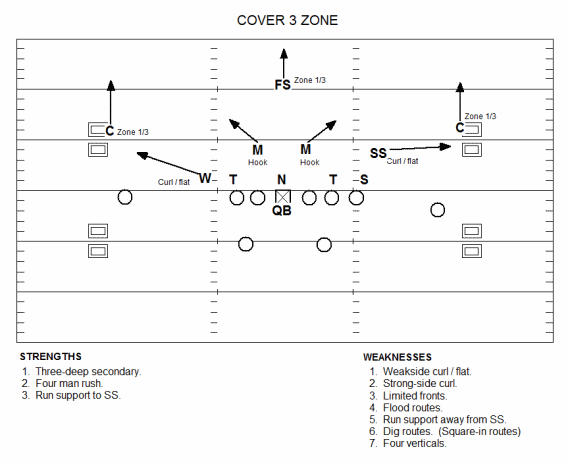
- Strengths
- Safe – always three deep
- strong side force against the run
- SS can get under an out and may be able to get under a stop or flat depending upon the wide receiver splits
- can cover eight zones with a three man rush
- can still bring four with strong side contain and have seven in coverage
- Weaknesses
- Versus eight in coverage the defense can only rush three with five or more to block them
- four defenders underneath to cover the six zones – large curl and horizontal seams
- no leverage on wide receivers; i.e., cannot bump or push inside
- possibly late to cover stop and flat, both weak and strong
- cannot cover a strong side flood route (three or four receivers in the pattern) without E, then it is a three man rush
- weak flat
- weakside force
- How to attack it:
- Stretch vertically and horizontally
- plenty of pass protection
- throw in the alley created by sending three on two in the perimeter (“flood type” routes)
- weakside curl & flat
- sprint away from SS
Three Deep – Rotate (“Cloud”)
The goal of this coverage is to take away the short passing game or protect against the wide side of the field when the offensive formation is strong into the boundary (short side). The PSR is based on the alignment of the SS and the C. The SS must be deeper than normal in order to cover the deep middle or deep outside (is aligned deeper than the adjacent C), the read is a rotate by SS; i.e., SS is covering the deep middle or outside. Also, in this coverage the C to the side of the rotation will be tight (up close) on the wide receiver as they have the flat. The secondary can disguise this by having both Cs up and on the snap the away (from the rotation) C back peddles to deep third [1/3] quickly (“bails”). However, we can determine the side of the rotation by the position of the Outside Linebacker (“OLB”). The OLB, whether W or S away from the rotation must be stacked or walked off as they have flat away from the rotation. You can confirm the 3D by the alignment of the FS. If the FS is off the hash and favoring the middle, assume 3D.
- Strengths
- Safe – always three deep
- force (to the rotation) against the run
- leverage by the C (shut down weak flat or out)
- can cover eight zones with a three man rush
- can still bring four with force and contain to the rotation, and have seven (7) in coverage
- easy to disguise
- Weaknesses
- Versus eight in coverage the defense can only rush three with five or more to block them
- only four defenders underneath to cover the six zones – large curl seams
- cushion on the wide receiver away from the rotation
- OLB is alone in the flat away from the rotation
- cannot cover a flood route (three or four [3 or 4] receivers in the pattern) • force and contain away from rotation
- How to attack it
- Flood routes – throw in the alley created by sending three on two in the perimeter (“flood type” routes)
- plenty of pass protection
- quick passes away from the rotation
- run away from rotation
- get TE involved
Two Deep – Five Under (Cover 2)
The PSR is based on the depth of the Cs and safeties. The Cs will usually be outside of the wide receivers and the safeties will be near the hash marks, aligned deeper than the corners. If the ball is on the hash, look to the strong side defensive back for their alignment because the safety will naturally be on the hash. If the end (“E”) drops to the curl, then all six (6) underneath zones are covered. When W has outside leverage on the second receiver, assume W has flat and rule out two (2) deep, five (5) under coverage and is possibly 3D rotation or Quarter-Quarter, Half.
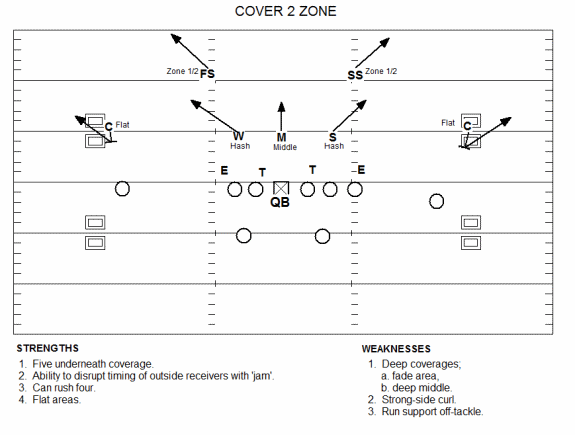
- Strengths
- Strong versus run
- leverage on both wide receivers
- cover five (5) of the six (6) underneath zones
- four (4) man rush
- takes away the outs
- can hold up the TE
- weakside force and contain
- Weaknesses
- Safeties must cover half (½) the field; i.e., the three (3) deep zones are covered by two
- inside receiver down the middle
- LBs must cover curl
- strong side contain
- weak inside linebacker to curl
- wide splits can create lanes
- How to attack it
- Use “Spread Formations” to horizontally stretch the safeties
- vertically stretch the flats to create lanes
- a natural hole twenty to twenty-five (20-25) yards along the sidelines
- weakside curl
- corner routes
- flood type routes
Cover 2 Man / Man under two-deep
This coverage is man-to-man with help over the top in the two (2) deep zones. This coverage allows the defense to bracket or double two (2) receivers. The PSR is based on the alignment of the Cs on the wide receivers. If the safeties give a 2D look (safeties near the hash marks, aligned deeper than the C’s) and both C’s are up tighter or looking primarily at the receiver instead of the QB, then Man Under Coverage (“MUC”) is confirmed. The Cs are the primary key, as they will usually be head up or shaded to the outside of the wide receivers. Also, the undercover (LB’s) will be head-up or at least in position to cover their man. Motion will force the undercover to adjust or run with the receiver.
Strengths
- Double or bracket two receivers
- four man rush
- every potential receiver is accounted for (covered)
- can bump because each defender has help over the top
- excellent versus zone type routes or screens
Weaknesses
- Poor run support
- mismatch with the backs versus linebackers
- hard to disguise versus motion
- three (3) deep zones are not covered
- one on one underneath
- crossing routes
- “bunch” and “snug” type sets
- How to attack it
- Back routes on the linebackers
- create mismatches with the TE running option (“read”) routes
- stay shallow with routes, catch the ball short and run long
- crossing routes (“mesh”) with the wide receivers
- TE in the alley or fades to the wide receivers
- running plays
- use motion
Cover 1 man / Man-to-man with a free safety.
This coverage is man-to-man with a FS to help over the top. The PSR is based on the alignment of the Cs and linebackers on the receivers. The C’s will be head up or in an outside alignment because they have help from the FS. This allows the C’s to take away the outs. Also, if the SS aligns head up on his eligible receiver at a tight to normal depth (four to six [4-6] yards) and the FS is deeper than normal (twelve to fifteen [12-15] yards), this will confirm the Man with a Free (“MwF”) coverage. The linebackers will have the backs man-to-man. The QB should anticipate pressure from a five (5) man rush, with the possibility of the defense bringing seven (7). The QB must identify whether a blitz is coming and throw the ball to the defenders vacated spot (i.e., “hot read”) or add protection with an audible.
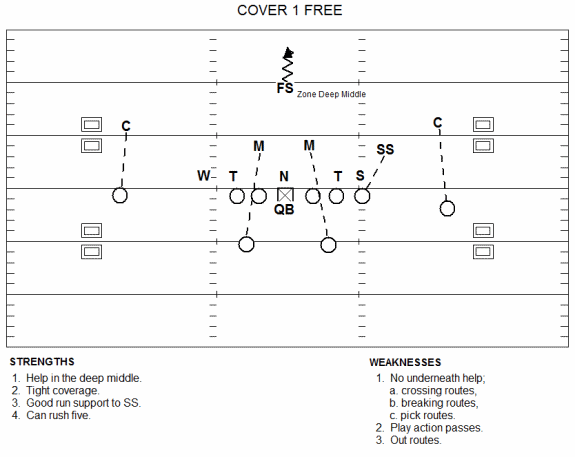
Strengths
- Pressure from a five (5) man rush
- every potential receiver is accounted for (covered)
- defenders have help to the post • excellent versus screens and delays
- C’s can play a tight man as they have help from the FS – crowd the receivers on third and five or longer
- excellent versus zone routes
- can take away the outs with an outside technique by the C’s
- speed on speed – good blitz coverage
- Weaknesses
- Poor run support
- mismatch with the backs versus linebackers
- hard to disguise versus motion
- three deep zones are not covered
- no under cover • crossing routes
- “bunch” and “snug” type sets
- How to attack it
- Back routes on the linebackers
- create mismatches with the TE running option (“read”) routes
- stay shallow with routes, catch the ball short and run long
- crossing routes (“mesh”) with the wide receivers
- TE in the alley or fades to the wide receivers
- running plays
- coverage away from FS by “looking off”
Cover 0 / Man-to-man blitz with no deep safety
This coverage is a straight man-to-man with no safety help. The PSR is based on the alignment of the safeties. Usually in Man coverage, the SS will play head up on the TE and the FS will play shallow on the weak side. Typically, there is no safety in the middle of the field. We can confirm this coverage by the inside leverage alignment by the Cs on the wide receivers. The C’s need this alignment as they have no inside help. The QB should anticipate pressure from a blitz. The QB must identify whether a blitz is coming and throw the ball to the defenders vacated spot or a crossing receiver; i.e., “hot read”. The QB could audible to add pass protection.
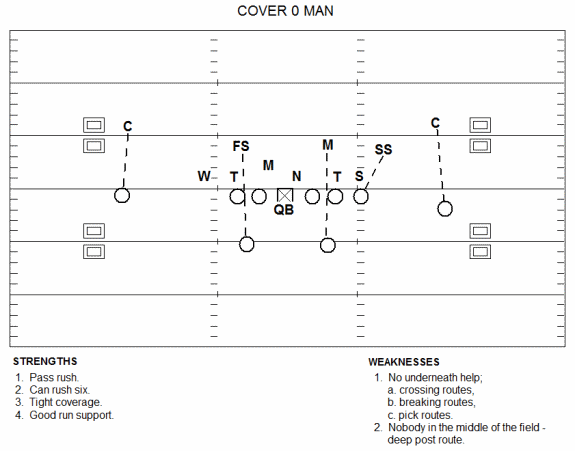
- Strengths
- Pressure (blitz capability) and penetration from a six to seven man rush
- big play potential
- clog up the running lanes inside
- force the offense to throw short
- Weaknesses
- Poor run support
- mismatch with the backs versus linebackers
- hard to disguise versus motion
- three deep zones are not covered
- no under cover
- crossing routes
- no deep help
- gamble defense
- “bunch” and “snug” type sets
- How to attack it
- Empty Formations — all receivers are one-on-one (but free rusher)
- tough to cover slants – nobody in the middle
- running plays – force and secondary force weakened
- should have somebody open if QB has time
Quarter, Quarter, Half
The Quarter, Quarter, Half (“QQH”) coverage provides three (3) defenders deep, however it uses one (1) defender to cover half (½) of the three (3) deep zones and two (2) defenders each covering a quarter (¼). The underneath coverage can utilize four or five (4 or 5) defenders. This coverage employs a traditional weak side 2D with a squat corner and half coverage safety. The strong side can employ a multitude of variations (invert and rolls). The most common is a bail technique by the strong side C covering the deep quarter (¼) with the strong side OLB covering curl to flat. The PSR is based on the depth and alignment of the C’s and safeties. The weakside or side away from the quarters alignment will look like a 2D with the C head-up or to the outside of the wide receiver and the safety near the hash marks, aligned deeper than the C. The strong C can be aligned head-up and tight, but will bail (retreat) so that they are off six to eight (6-8) yards at the snap. The SS will be even with the C at the snap, and can also employ a bail technique.
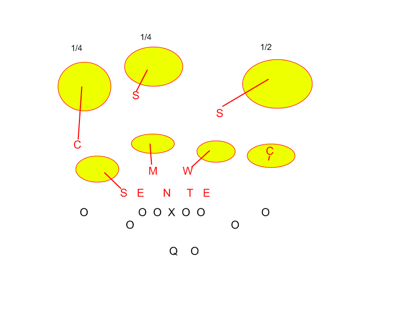
- Strengths
- Leverage on weak wide receiver, can use bump technique
- deep routes to strong side
- cover five (5) of the six (6) underneath zones
- four (4) man rush
- weakside force and contain
- easy to disguise
- can double (inside/outside) against a single receiver to the weak side
- Weaknesses
- Weak safety must cover half the field
- flood routes to the strong side
- S must cover curl and flat
- strong side contain
- weak inside linebacker to curl
- wide splits can create lanes
- How to attack it
- Horizontal stretch on the safety covering half
- vertically stretch the flats to create lanes
- strong side outs
- weakside curl
- cannot cover a flood route (three or four [3 or 4] receivers in the pattern)
- trips type formations & motion
Zone Blitz
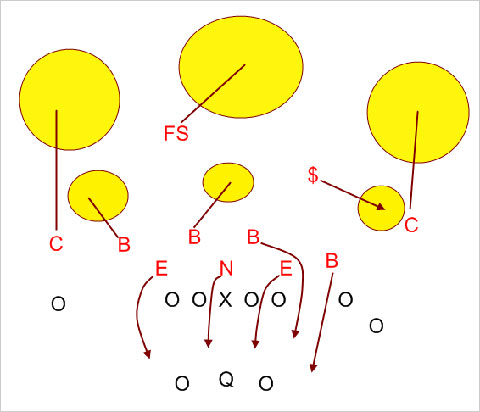
The Zone Blitz is a defensive scheme used to confuse the offensive line’s pass protection schemes, and the QB’s reads. A frontal rusher — i.e. a linebacker or defensive lineman – briefly engages the offensive lineman, then retreats to his pass zone, if he reads pass. The blitzers go through their assigned gaps. The droppers replace the blitzers in the pass zone. The coverage could be anything, but the most common zone blitz is the “fire zone,” which involves three deep and three intermediate pattern reading defenders.
- Strengths
- Run lanes are covered
- pressure on the QB – confuse protection schemes
- QB reads are changed
- easy to disguise
- can double (inside/outside) against outside receivers and cover underneath zone with defensive linemen
- Weaknesses
- Defensive linemen and other defenders in coverage who are not skilled/used to it – limited range
- crossing routes through the underneath coverage
- play action, if offense can protect
- How to attack it
- Horizontal and vertical stretch on the pass zones
- TE versus defensive linemen
- screen passes
- play action, with patterns to the backs
- Maximum protection with deep combinations through the open areas
Cover 1 “Robber”
The Robber coverage is a defensive scheme used to confuse the QB’s reads. It is designed to take away the middle pass zones, both the underneath and deep middle. It can be employed out of a four across or two deep look. A QB reading through the middle of the field (goal post) will read man or rotation and attempt to hit crossing routes or attack the deep middle which is where the “robber” is. The coverage can also be used with man coverage allowing the “robber” helping out in the middle.
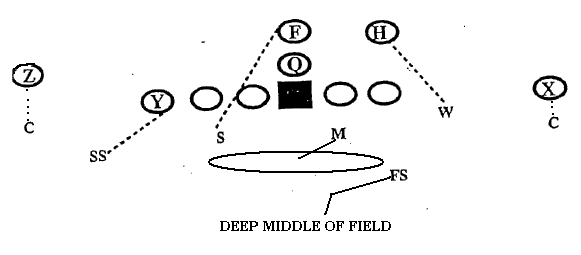
- Strengths
- Middle zones
- confuse QB’s reads
- easy to disguise
- can double (inside/outside) against inside receivers
- can lock-on QB’s eyes
- Weaknesses
- Deep outside versus man
- outside breaking routes by inside receivers
- play action
- How to attack it
- Outside on timing routes
- play action with deep routes
- crossing routes to the outside versus man
- QB must look robber off
- clear lane throws
Prevent
The Prevent is a defensive scheme designed to force the offense to use time to score. It protects against the quick scores, while allowing the offense to pick up chuncks of yardages. The QB must be descipline when facing the Prevent by taking the easy yardage. At the high school and collegiate level, attack the middle of the prevent because the clock stops to move the chains for first downs. The defense linemen will use outside rush techniques to keep the QB in the pocket. The QB must be patient throwing in the underneath zones to recievers on the run.
- Strengths
- Deep zones, four defenders deep
- can get under deep outs and curls
- can keep the QB in the pocket with an outside rush
- defensive backs can fly to the ball when it is thrown deep
- protect the boundary
- Weaknesses
- Inside run – draws
- backs on delays to middle
- middle hook zones
- quick routes on time
- in the undercover seams
- How to attack it
- Horizontally stretch the pass zones
- deep crossing routes
- underneath at twelve yards or less with stops, flats and outs on time
- empty sets
- draws
- backs on delays
- get the ball to speed underneath
Review
A critical component to a successful pass is that the quarterback recognize the coverage. Materials given to a quarterback (DVD, flash cards)
- Quick recognition of the secondary.
- The strengths and weaknesses of the coverage.
- Where to attack the coverage based upon the play called.
Wednesday, November 18, 2009
COACHES CHECKLIST FOR OFFENSIVE GAME PLANNING
COACHES CHECKLIST FOR OFFENSIVE GAME PLANNING
by Hank Schrader, Bellevue (WA) High School - The Coaches Checklist for Offensive Game Planning
• Offensive Strategy
• Running Attack
• Passing Attack
• Developing a game plan
OFFENSIVE STRATEGY
Balance- what kind of balance of run to pass plays ratio do you want
Diversity- multiple points of attack
Flexibility- an ability to adjust plays to attack defensive schemes and weaknesses
Deceptiveness- using run and pass plays that look alike to confuse defenses
- Switching assignments on same play
OFFENSIVE EMPHASIS:
Attack- Strike the first blow
Dictate- force the defense to match your formation and game tempo
Execution- you win by how well you performed the designed play
Be unpredictable- confused defenses play slow
STYLES OF PLAY:
Field Position Theory- play calls designed by field position
Ball Control Theory- 3 yards and a cloud of dust, keep away from opponent
Big Play Theory- chop away then go for the big play
Running Game Theory- run the ball more
Passing Game Theory- throw the ball more unless forced to
RUNNING ATTACK
ESTABLISHING THE RUN
YOUR RUN GAME NEEDS 3 KIND OF PLAYS:
Power Game- getting more players to the point of attack than the defense
Speed Game- Plays in which the ball carrier quickly attacks the L.O.S. before the defense can react
Finesse Game- plays based on misdirection to fool the defenders
12 QUESTIONS TO CONSIDER WHEN FORMING YOUR RUNNING ATTACK:
1. What plays should we run ?
2. Where should we run the play ?
3. We should we avoid running ?
4. How can we dictate defensive alignments by our formations, shifts, and motions ?
5. How many yards rushing are needed to win the game ?
6. How many times do we want to run ?
7. How many practice reps do we need to accomplish our goal?
8. How many different sets do we need to win this game?
9. How many tight end and split end formations do we need to use to win ?
10. How will field position change our running game (both hash marks and by vertical field positions)
11. Do we need an audible run plan for this game?
12. What is our plan for the following situations :
- Short yardage
- Goal line
- Danger zone
- Red zone
- 2 minute offense
- Slow down offense
- 2 point conversions
- Must have first downs
- Killing the clock
RUNNING STRATEGY BY DOWN AND DISTANCE:
FIRST AND 10:
- Use your best ball carrier
- Quick hitting dives and traps
- Try for positive runs of 3-5 yards or sweeps to the outside for a sure gain
- Defenses vary looks on first down- sweeps, zone, toss
SECOND AND LONG:
- Use high % runs to get into 3rd and medium/short situation
- Counters, reverses, bootlegs
- Run/Pass option plays are excellent
- Draws can be successful since defenders will make their drops sooner and deeper
- Play action passes
THIRD AND LONG (10 or MORE)
- Use your fastest ball carrier with big play potential
- Need to designate plays with big play potential
- Avoid screens and draws (Defenses expect this)
- Run pass option plays
- Must prepare players mentally for this situation
2nd 3RD AND 7-10
- Spread the field if possible and use traps or counters
- Use the back with the best chance of getting the first down
- Quick toss plays
- 3 step pass game
3RD AND 4-6
- DEFENSES often use their best formation/call in this situation so go with your best call
- Force the defense out of their comfort zone by forcing a switch in alignment, or tempo
- Your runner must get up field on one cut, no dancing
- Often the defense will blitz so consider a run-pass option play
3rd and SHORT (3 or less)
- Power type plays with lead blocker (iso, belly, power)
- Run away from opponents strength
- Use most consistent back and best blockers
- Change up cadences (go on first sound or 2 or 3)
- RUNNING STRATEGY BY DOWN AND DISTANCE:
RED ZONE (opp. 25 AND IN)
- Anticipate man coverage, use quick hitters and more consistent plays
- Give the ball to the 2nd back using lead blocker type plays
- Anticipate blitzes: use draws, traps, screens, and tricks possibly
RED ZONE (15 and IN)
- Consider roll out, sprint passing game, with possiblility of QB run
- Make the defense defend the entire field with counters, reverses, sweeps
- Attack weakest links of defenses
- Use the run to set up the pass (sweep then fake sweep bootleg pass)
DOWN AND GOAL RED ZONE
- Eliminate mistakes
- Best back should run behind best blockers
- Protect the football and eliminate extra ball handling
- Run your best plays
- Must score
DANGER ZONE - BACKED UP (your own 30 to your own goalline)
- Use quick hitters with most reliable back
- Avoid slow to develop plays
- If on the goaline, you must gain at least 5 yards for the punter to not be crowded
COMPOENENTS FOR BUILDING A SUCCESSFUL PASSING GAME:
• You must develop a wide (horizontal) and deep (vertical) game
• A TOTAL PASS PACKAGE includes: drop back passes (3, 5, 7, 9, step drops), quick passes, sprint out passes, play action passes, screens, and some sort of blitz control
• Time to throw is critical meaning you can’t throw it if you can’t block it
12 QUESTIONS TO CONSIDER WHEN FORMING PASS GAME PLAN:
1. What pass plays should we run
2. Where should we pass
3. Where should we avoid passing
4. How can we make the defense change alignment by motions, shifts, and formations
5. How many yards passing do we need to win the game
6. How many times do we want to pass
7. How many practice reps do we need to accomplish these goals
8. How many different sets to we need for this game
9. How many tight end or split end sets do we need
10. How will field position change our passing game
11. Do we need an audible pass plan for this game
12. What is our plan / call for certain situations
PASSING ATTACK BY DOWN AND DISTANCE:
1st and 10:
- Use play action passes that look like run plays
- Utilize high % quick throws (3 step game)
- Qb must not take a sack
- Defenses vary their looks the most in this situation so disguise high % plays
2nd and long:
- Use high % calls to get to 2nd and medium or less
- Have your qb use rhythm throws of 3 or 5 step drops with an option to 2nd level if short receivers are covered
- This is a blitz down, use a hot receiver
- Delay routes are effective, DBs use drops sooner and deeper
3rd and 12 or more:
- deep flag routes are usually high % throws, switch routes, dig routes, are also very good
- consider hook routes and running plays vs. soft zone
- Consider keeping one blocker in to give QB time and play call to develop
3rd and 7-10
- Possible blitz situation- Think Max Protection
- Use hooking routes vs. zone coverage and comeback routes on boundaries vs. man
- Short crosses and delays are also good in this situation
- QB has more time to wait for WRs to get open, WHY? A sack on 3rd down is not as bad as a sack on other downs
3rd and 4-6
- Defenses are going to use their best call, QB and WR pre snap reads are critical
- WR must be aware of first down marker and run route accordingly
- WR must get up field after catch
- Common blitzing down, have a hot receiver
3rd and 3 or less
- Expect tight coverage, so WR must push hard to get up field, Teach WRS to get up field and break contact at LOS
- Hot receiver must always be ready for the ball
- Out routes in the flats should be ran at least 1 yard pass first down marker
PASSING ATTACK BY ZONE (FIELD POSITION)
Red Zone (25 and in)
- Anticipate man coverage
- Use at least 1 play with possible TD ability
- Anticipate blitzes , think hot routes, and protection adjustments
Red Zone (15 and in)
- Use crossing routes and attack corners of endzone – teach QB to lead receivers when throwing into this area
- Have a blitz plan
- Recievers must know to find the back of the endzone if original route breaks down
- Use distinct receiver breaks and push hard – reduced room = tighter coverage
Red Zone (down and goal)
- Receivers must run all routes over the goaline
- Use crossing and play action routes
- QB must not take a sack, get rid of the ball
- Misses must be outside and deep, do not throw off the back foot or late
- Recievers must work to get to the back of the endzone if route breaks down
- Expect tight coverage, teach receivers how to break free
Danger Zone - Backed up (your 30 and in)
- Have a hot receiver ready in case of blitz
- Use isolation routes on the edges away from traffic
- Use max protection to give your QB time
DEVELOPING AN OFFENSIVE GAME PLAN
9 Steps for Developing your Game Plan:
1. Break down game film of your opposition
2. Self scouting is crucial
3. Gather printed scouting material
4. Create scouting reports
5. Diagram / staff chalk talk
6. Develop the game plan
7. Educate your players
8. Design the practice
9. Execute the game plan
• GAME FILM OF YOUR OPPOENENT:
What is their basic defensive scheme ?
Do they play passively or attack ?
What are their situational defenses ?
What are their tendencies by field position, formation, and down & distance ?
• SELF SCOUTING
Are you faking well ?
Do you run the same exact play in the same exact situation ?
Do you substitute one player than give him the ball ?
Is your team predictable ?
• GATHER PRINTED SCOUTING MATERIAL
With your film breakdown determine:
Their best players by position
Who is their best tackler, best pass rusher, best coverage player
Relative strength of DLs, LBs, DBs
Key backups and situational subs
Tip offs such as blitz alignments
Position techniques of opponents such as favorite moves
• CREATE SCOUTING REPORT
Profile the opposition by: height, weight, starters, numbers, class, best and worst players
Diagram defensive fronts and coverages with notes for players
List play % on fronts, coverages, blitzes, by down and distance, and field position
Tell your team what they must do to win
• DIAGRAM / STAFF CHALK TALK
Staff needs to focus on play selection and blocking schemes
Select your play list from master play list and adjust blocking scheme if necessary
Consider developing a list of best plays versus certain defenses/fronts
• DEVELOPING THE GAME PLAN
Two Types of Game Plans:
Situational - plays organized by down and distance
Script- pre determined plays from a script with a plan for situations that call to go off script
• EDUCATE YOUR PLAYERS
Its not what you know, its what they know
If you have a film session reviewing previous game, afterwards have a quick overview of upcoming game
Monday- give out scouting report, only include information that players will need to succeed
Practice new plays or seldom used plays , handouts with blocking adjustments helpful
Keep education process going Tuesday and Wednesday with final review on Thursday
• DESIGNING PRACTICES
Monday: individual and group skills, some team front and coverage recognition
Tuesday: features group and team units with the 1st team look at scout defense (scripted), adjust game plan if needed
Wednesday: Team live vs. scout in scripted special situations
Thursday: Run through script vs bags, make sure each play is executed perfectly, if I do not run a play 10 times in practice, I will not use it in a game
How you accomplish this task is not as important as establishing a practice routine that your players know and understand
• EXECUTING THE GAME PLAN
Get a moment alone to practice your play calling while watching film. Before a team meeting, check in with the booth coaches to review game plan and forms and to insure they know what to look for. Review the game plan with the team and any last minute reminders. Game time communication- develop sound techniques and procedures. Look for early adjustments and fix them quickly. At the end of each series coaches must provide feedback, make sure players know what is expected
Halftime adjustments: What were our most successful plays (CHART PLAYS !) Why ? What must we do to win this game?
Never forget the players. Its not the X and Os, it’s the Jimmies and Joes. If you got a stud, make sure you use him all you can despite criticism.
by Hank Schrader, Bellevue (WA) High School - The Coaches Checklist for Offensive Game Planning
• Offensive Strategy
• Running Attack
• Passing Attack
• Developing a game plan
OFFENSIVE STRATEGY
Balance- what kind of balance of run to pass plays ratio do you want
Diversity- multiple points of attack
Flexibility- an ability to adjust plays to attack defensive schemes and weaknesses
Deceptiveness- using run and pass plays that look alike to confuse defenses
- Switching assignments on same play
OFFENSIVE EMPHASIS:
Attack- Strike the first blow
Dictate- force the defense to match your formation and game tempo
Execution- you win by how well you performed the designed play
Be unpredictable- confused defenses play slow
STYLES OF PLAY:
Field Position Theory- play calls designed by field position
Ball Control Theory- 3 yards and a cloud of dust, keep away from opponent
Big Play Theory- chop away then go for the big play
Running Game Theory- run the ball more
Passing Game Theory- throw the ball more unless forced to
RUNNING ATTACK
ESTABLISHING THE RUN
YOUR RUN GAME NEEDS 3 KIND OF PLAYS:
Power Game- getting more players to the point of attack than the defense
Speed Game- Plays in which the ball carrier quickly attacks the L.O.S. before the defense can react
Finesse Game- plays based on misdirection to fool the defenders
12 QUESTIONS TO CONSIDER WHEN FORMING YOUR RUNNING ATTACK:
1. What plays should we run ?
2. Where should we run the play ?
3. We should we avoid running ?
4. How can we dictate defensive alignments by our formations, shifts, and motions ?
5. How many yards rushing are needed to win the game ?
6. How many times do we want to run ?
7. How many practice reps do we need to accomplish our goal?
8. How many different sets do we need to win this game?
9. How many tight end and split end formations do we need to use to win ?
10. How will field position change our running game (both hash marks and by vertical field positions)
11. Do we need an audible run plan for this game?
12. What is our plan for the following situations :
- Short yardage
- Goal line
- Danger zone
- Red zone
- 2 minute offense
- Slow down offense
- 2 point conversions
- Must have first downs
- Killing the clock
RUNNING STRATEGY BY DOWN AND DISTANCE:
FIRST AND 10:
- Use your best ball carrier
- Quick hitting dives and traps
- Try for positive runs of 3-5 yards or sweeps to the outside for a sure gain
- Defenses vary looks on first down- sweeps, zone, toss
SECOND AND LONG:
- Use high % runs to get into 3rd and medium/short situation
- Counters, reverses, bootlegs
- Run/Pass option plays are excellent
- Draws can be successful since defenders will make their drops sooner and deeper
- Play action passes
THIRD AND LONG (10 or MORE)
- Use your fastest ball carrier with big play potential
- Need to designate plays with big play potential
- Avoid screens and draws (Defenses expect this)
- Run pass option plays
- Must prepare players mentally for this situation
2nd 3RD AND 7-10
- Spread the field if possible and use traps or counters
- Use the back with the best chance of getting the first down
- Quick toss plays
- 3 step pass game
3RD AND 4-6
- DEFENSES often use their best formation/call in this situation so go with your best call
- Force the defense out of their comfort zone by forcing a switch in alignment, or tempo
- Your runner must get up field on one cut, no dancing
- Often the defense will blitz so consider a run-pass option play
3rd and SHORT (3 or less)
- Power type plays with lead blocker (iso, belly, power)
- Run away from opponents strength
- Use most consistent back and best blockers
- Change up cadences (go on first sound or 2 or 3)
- RUNNING STRATEGY BY DOWN AND DISTANCE:
RED ZONE (opp. 25 AND IN)
- Anticipate man coverage, use quick hitters and more consistent plays
- Give the ball to the 2nd back using lead blocker type plays
- Anticipate blitzes: use draws, traps, screens, and tricks possibly
RED ZONE (15 and IN)
- Consider roll out, sprint passing game, with possiblility of QB run
- Make the defense defend the entire field with counters, reverses, sweeps
- Attack weakest links of defenses
- Use the run to set up the pass (sweep then fake sweep bootleg pass)
DOWN AND GOAL RED ZONE
- Eliminate mistakes
- Best back should run behind best blockers
- Protect the football and eliminate extra ball handling
- Run your best plays
- Must score
DANGER ZONE - BACKED UP (your own 30 to your own goalline)
- Use quick hitters with most reliable back
- Avoid slow to develop plays
- If on the goaline, you must gain at least 5 yards for the punter to not be crowded
COMPOENENTS FOR BUILDING A SUCCESSFUL PASSING GAME:
• You must develop a wide (horizontal) and deep (vertical) game
• A TOTAL PASS PACKAGE includes: drop back passes (3, 5, 7, 9, step drops), quick passes, sprint out passes, play action passes, screens, and some sort of blitz control
• Time to throw is critical meaning you can’t throw it if you can’t block it
12 QUESTIONS TO CONSIDER WHEN FORMING PASS GAME PLAN:
1. What pass plays should we run
2. Where should we pass
3. Where should we avoid passing
4. How can we make the defense change alignment by motions, shifts, and formations
5. How many yards passing do we need to win the game
6. How many times do we want to pass
7. How many practice reps do we need to accomplish these goals
8. How many different sets to we need for this game
9. How many tight end or split end sets do we need
10. How will field position change our passing game
11. Do we need an audible pass plan for this game
12. What is our plan / call for certain situations
PASSING ATTACK BY DOWN AND DISTANCE:
1st and 10:
- Use play action passes that look like run plays
- Utilize high % quick throws (3 step game)
- Qb must not take a sack
- Defenses vary their looks the most in this situation so disguise high % plays
2nd and long:
- Use high % calls to get to 2nd and medium or less
- Have your qb use rhythm throws of 3 or 5 step drops with an option to 2nd level if short receivers are covered
- This is a blitz down, use a hot receiver
- Delay routes are effective, DBs use drops sooner and deeper
3rd and 12 or more:
- deep flag routes are usually high % throws, switch routes, dig routes, are also very good
- consider hook routes and running plays vs. soft zone
- Consider keeping one blocker in to give QB time and play call to develop
3rd and 7-10
- Possible blitz situation- Think Max Protection
- Use hooking routes vs. zone coverage and comeback routes on boundaries vs. man
- Short crosses and delays are also good in this situation
- QB has more time to wait for WRs to get open, WHY? A sack on 3rd down is not as bad as a sack on other downs
3rd and 4-6
- Defenses are going to use their best call, QB and WR pre snap reads are critical
- WR must be aware of first down marker and run route accordingly
- WR must get up field after catch
- Common blitzing down, have a hot receiver
3rd and 3 or less
- Expect tight coverage, so WR must push hard to get up field, Teach WRS to get up field and break contact at LOS
- Hot receiver must always be ready for the ball
- Out routes in the flats should be ran at least 1 yard pass first down marker
PASSING ATTACK BY ZONE (FIELD POSITION)
Red Zone (25 and in)
- Anticipate man coverage
- Use at least 1 play with possible TD ability
- Anticipate blitzes , think hot routes, and protection adjustments
Red Zone (15 and in)
- Use crossing routes and attack corners of endzone – teach QB to lead receivers when throwing into this area
- Have a blitz plan
- Recievers must know to find the back of the endzone if original route breaks down
- Use distinct receiver breaks and push hard – reduced room = tighter coverage
Red Zone (down and goal)
- Receivers must run all routes over the goaline
- Use crossing and play action routes
- QB must not take a sack, get rid of the ball
- Misses must be outside and deep, do not throw off the back foot or late
- Recievers must work to get to the back of the endzone if route breaks down
- Expect tight coverage, teach receivers how to break free
Danger Zone - Backed up (your 30 and in)
- Have a hot receiver ready in case of blitz
- Use isolation routes on the edges away from traffic
- Use max protection to give your QB time
DEVELOPING AN OFFENSIVE GAME PLAN
9 Steps for Developing your Game Plan:
1. Break down game film of your opposition
2. Self scouting is crucial
3. Gather printed scouting material
4. Create scouting reports
5. Diagram / staff chalk talk
6. Develop the game plan
7. Educate your players
8. Design the practice
9. Execute the game plan
• GAME FILM OF YOUR OPPOENENT:
What is their basic defensive scheme ?
Do they play passively or attack ?
What are their situational defenses ?
What are their tendencies by field position, formation, and down & distance ?
• SELF SCOUTING
Are you faking well ?
Do you run the same exact play in the same exact situation ?
Do you substitute one player than give him the ball ?
Is your team predictable ?
• GATHER PRINTED SCOUTING MATERIAL
With your film breakdown determine:
Their best players by position
Who is their best tackler, best pass rusher, best coverage player
Relative strength of DLs, LBs, DBs
Key backups and situational subs
Tip offs such as blitz alignments
Position techniques of opponents such as favorite moves
• CREATE SCOUTING REPORT
Profile the opposition by: height, weight, starters, numbers, class, best and worst players
Diagram defensive fronts and coverages with notes for players
List play % on fronts, coverages, blitzes, by down and distance, and field position
Tell your team what they must do to win
• DIAGRAM / STAFF CHALK TALK
Staff needs to focus on play selection and blocking schemes
Select your play list from master play list and adjust blocking scheme if necessary
Consider developing a list of best plays versus certain defenses/fronts
• DEVELOPING THE GAME PLAN
Two Types of Game Plans:
Situational - plays organized by down and distance
Script- pre determined plays from a script with a plan for situations that call to go off script
• EDUCATE YOUR PLAYERS
Its not what you know, its what they know
If you have a film session reviewing previous game, afterwards have a quick overview of upcoming game
Monday- give out scouting report, only include information that players will need to succeed
Practice new plays or seldom used plays , handouts with blocking adjustments helpful
Keep education process going Tuesday and Wednesday with final review on Thursday
• DESIGNING PRACTICES
Monday: individual and group skills, some team front and coverage recognition
Tuesday: features group and team units with the 1st team look at scout defense (scripted), adjust game plan if needed
Wednesday: Team live vs. scout in scripted special situations
Thursday: Run through script vs bags, make sure each play is executed perfectly, if I do not run a play 10 times in practice, I will not use it in a game
How you accomplish this task is not as important as establishing a practice routine that your players know and understand
• EXECUTING THE GAME PLAN
Get a moment alone to practice your play calling while watching film. Before a team meeting, check in with the booth coaches to review game plan and forms and to insure they know what to look for. Review the game plan with the team and any last minute reminders. Game time communication- develop sound techniques and procedures. Look for early adjustments and fix them quickly. At the end of each series coaches must provide feedback, make sure players know what is expected
Halftime adjustments: What were our most successful plays (CHART PLAYS !) Why ? What must we do to win this game?
Never forget the players. Its not the X and Os, it’s the Jimmies and Joes. If you got a stud, make sure you use him all you can despite criticism.
Monday, November 2, 2009
10 things about coaching ball
1. The job you have right now is the best one in the world. you will look back when you move on and say to yourself, I wish I would have enjoyed that experience more
2. Never stop learning and asking questions...remember those guys your asking were not born with that knowledge out of the womb
3. Enjoy the process. The product will come and it will be that much more rewarding. If you really work at it you'll succeed.
4. Be loyal to the guys you are working with and for. I read on one of the threads that the OL coach was underminding the OC. For what purpose? Did it help them win? In my opinion there is no place for this on a staff and must be dealt with by the HC immediately.
5. Believe in a philosophy and run with it. Know it so well you will have the answers to make adjustments.
6. While evaluating players dont pigeon hole a kid. How can he best help your team win. Thats whats important.
7. The only way a true team can survive is from the inside out. That goes for families, businesses etc. If you are strong inside your group who can tear it apart....no one
8. I would tell my coaches to coach the performance and never demean a player. I have found that players want to be coached and by coaching them hard they will respond if they know you are there to help them and care about them. This is especially true on the upper levels also. I would tell my coaches what if a player comes back on you? You are in a no Win situation. Take the player aside and keep both yours and his dignity intact.
9. There are no badges of honor for the guy that can stay there the latest. I would tell my staff when you get yourself done go home. The biggest pet peeve I have in coaching is when a coach tells everyone how late he stayed. Those guys are not on my staff. We have always gone into games prepared. Take a look at your watch right now and draw a three technique on your board. Go home and come back at three in the morning and he will still be a three. Go find out a way to block him. You can both be a great coach and a great family man. We had just recently moved and we were unpacking...there were some old pictures of my kids. It saddened me to not have remembered those times with them because I wont have the opportunity to get those times in their lives back. Your kids only turn a certain age once be there.
10. Have fun, its a game. When you look back on your career you will remember the players and coaches. The people you surrounded yourself with. I promise on your death bed you wont be thinking about cover three.
2. Never stop learning and asking questions...remember those guys your asking were not born with that knowledge out of the womb
3. Enjoy the process. The product will come and it will be that much more rewarding. If you really work at it you'll succeed.
4. Be loyal to the guys you are working with and for. I read on one of the threads that the OL coach was underminding the OC. For what purpose? Did it help them win? In my opinion there is no place for this on a staff and must be dealt with by the HC immediately.
5. Believe in a philosophy and run with it. Know it so well you will have the answers to make adjustments.
6. While evaluating players dont pigeon hole a kid. How can he best help your team win. Thats whats important.
7. The only way a true team can survive is from the inside out. That goes for families, businesses etc. If you are strong inside your group who can tear it apart....no one
8. I would tell my coaches to coach the performance and never demean a player. I have found that players want to be coached and by coaching them hard they will respond if they know you are there to help them and care about them. This is especially true on the upper levels also. I would tell my coaches what if a player comes back on you? You are in a no Win situation. Take the player aside and keep both yours and his dignity intact.
9. There are no badges of honor for the guy that can stay there the latest. I would tell my staff when you get yourself done go home. The biggest pet peeve I have in coaching is when a coach tells everyone how late he stayed. Those guys are not on my staff. We have always gone into games prepared. Take a look at your watch right now and draw a three technique on your board. Go home and come back at three in the morning and he will still be a three. Go find out a way to block him. You can both be a great coach and a great family man. We had just recently moved and we were unpacking...there were some old pictures of my kids. It saddened me to not have remembered those times with them because I wont have the opportunity to get those times in their lives back. Your kids only turn a certain age once be there.
10. Have fun, its a game. When you look back on your career you will remember the players and coaches. The people you surrounded yourself with. I promise on your death bed you wont be thinking about cover three.
a good play to put in
"Putting Out the Fire (Zone)" - Gunter Brewer (Part II)

Another way OSU looks to attack the fire zone is with their quick passing game.
(for a detailed view of the staple of OSU’s passing attack, the four verticals package, check out Chris Brown’s blog)
SCAT out of 3 x 1
The scat concept out of 3 x 1 is a great way of exposing the horizontal stretch of a 3 underneath zone coverage. It is an evolution of Y Stick, and further evolved itself to the current spacing concept.

Just like the spacing concept detailed before, the inside receivers are looking to put the middle hole defender in conflict. They work to get in between the MLB and the PSL B at 6 yards and sit down.
The Z (playside outside receiver) runs the clearing fade (FOR / Force Outside Release) to draw greater a void underneath. The shoot by the F converts to a wheel if seeing press man coverage.
The added benefit of 3 x 1 is the bubble route run by the H. This not only provides a release outlet, but also stretches the SCIF player to defend the sideline to the hash.
Regardless of the coverage, this concept is adaptable and can stress the defense regardless of the assignment. The X & Y run a “sneak” (stick) route at a depth of 6 yards to 2-on-1 attack the MLB.

- Vs zone – split the difference between defenders
- Vs man – push in hard and bounce back out
If the linebacker crosses the receiver's face, he should look for the ball. If the receiver gets walled (from an inside stem), he will sit and bounce back out (working off of MLB)
This provides a failsafe plan of attack for the quarterback. All he has to determine is if it is MOFC or MOFO coverage and then immediately attack the appropriate defender.
- Vs 1 high – look weak (key the flat defender)
- Vs 2 high – look strong (key the flat defender)
- Vs man – Sneak/Wheel
It is important to see the seams / voids created with so much defensive movement of players replacing one another.
“You have to get them, before they get you”


Attacking the Linebackers
Against the zone blitz, the inside receiver should look for the dropper (weight not on the hands), and anticipate his drop. The rationale on spotting the dropper, is because in 3x1 the MLB is the target. He will have to expand to #3 away from the hole to match #3’s route dispersion.

When the playside linebacker is in man coverage, he will not be sitting or dropping to the seam, he will be expanding to chase the back on flare (leaving a large void in the area he is leaving). The WR to the chasing linebacker must look for the ball in his first 3 steps. To take advantage of this big-play potential, it is important to identify the coverage presnap via shifts, motions, and altering the tempo.

If the linebacker drops, the receiver will go underneath, work the hole inside, and off the drop of the MLB.

If the linebacker “sits”, the WR must decide the over/under position to best work (find the hole).

If the linebacker walls or prevents an inside release (typically if the defense is aggressively trying to stop follows, meshes, etc) the WR should use a bounce technique and work back outside.

The following is an example of the evolution of the (double stick) scat concept (and how it helped evolve spacing)
Shown here by BYU and NC State, featuring a young Philip Rivers
Does this Y Stick concept from Norm Chow's 1995 playbook look familiar?

It should
Y Stick vs the Fire Zone
This is a great concept to work against the leverage of hole and seam players. This also works against both 1-high (MOFC) and 2-high (MOFO) coverages equally well. Where spacing featured 3 sticks, Scats featured 2 sticks, now Y Stick features just the TE sticking based on the MLB.

1 high defense
With the backside 2 receiver combo, the inside receiver route essentially becomes the shoot route being run on the TE side. Rather than elongate the throw by immediately pressing the sideline, the receiver vertically presses 6 yards and then keys the corner on whether he should sit (if corner sits / flat) or continue expanding to the flat (if corner retreats).

2 high defense
An illustration of the stick concept vs 2-high defense against Texas Tech (actually the very play that the opening picture was taken from)


This play / pictorial best illustrates identifying the 'hot' key of a man-linebacker. Watch the 8 technique SLB racing to chase the shooting F out of the backfield. The SLB isn't dropping, he is quickly widening flat. Recognizing this, the Y quickly turns his shoulder in anticipation of receiving this quick throw.


Once the QB identified man-coverage, he locks onto his Y and is going to deliver the ball away to the shoulder away from the MLB on his hitch step.
(Very little thining required here - just react to the immediate key)


The TE makes a great catch outside his body, which affords him more room and momentum to turn upfield away from the MLB. Now it is the Y versus the Safety.


The receiver runs over the safety, the chase ensues, and makes a bad-angled corner miss.....and its SHOWTIME in the endzone!


Thursday, October 15, 2009
How to turn this situation around
1. Have an attendance policy and stick to it.
All absences must be notified to the coach before hand or they are considered unexcused. If you are sick from school, the absence is excused and no added conditioning. For all other excused absences:
1 absence= 100 updowns and no start
2nd abscence= 100 updowns and no first half
3rd absence= 100 updowns and no dress
This is on a weekly basis.
3 unexcused absences a year and you are removed from the team. Once you quit or are removed there is no coming back.
2. Build a weight program and require kids to attend.
3. Run a systematic offense. I would recommend running something that is not run in your league ala double wing or Navy Flexbone.
4. Build relationships with everyone.
5. Teach fundamentals over scheme.
6. Do it your way, you may get fired, but if you do the job wasn't worth it.
7. Teach character over winning.
8. Create high expectations for the classroom.
9. Don't accept background as an excuse.
10. Drug test, if it is legal and there are funds.
All absences must be notified to the coach before hand or they are considered unexcused. If you are sick from school, the absence is excused and no added conditioning. For all other excused absences:
1 absence= 100 updowns and no start
2nd abscence= 100 updowns and no first half
3rd absence= 100 updowns and no dress
This is on a weekly basis.
3 unexcused absences a year and you are removed from the team. Once you quit or are removed there is no coming back.
2. Build a weight program and require kids to attend.
3. Run a systematic offense. I would recommend running something that is not run in your league ala double wing or Navy Flexbone.
4. Build relationships with everyone.
5. Teach fundamentals over scheme.
6. Do it your way, you may get fired, but if you do the job wasn't worth it.
7. Teach character over winning.
8. Create high expectations for the classroom.
9. Don't accept background as an excuse.
10. Drug test, if it is legal and there are funds.
Thursday, October 8, 2009
The Colts
Plays are simple & basic. Runs are Inside Zone, Counter, Stretch, Draw, etc. Passes roughly same as everybody elses'. They KEEP IT SIMPLE & OUT-EXECUTE PEOPLE.
Personnel = basically 1 TE - 3 WR - 1 RB, AND, 2 TE - 2 WR - 1 RB. They can go from one to the other by flexing Dallas Clark out as a WR, or bringing him in tight as a second TE (he is good enough to do both).
The PLAY CALLING at the LOS is the big thing. Essentially, they give Manning a 3 play package of choices (run left, run right, pass). He makes the decision based upon the number of safeties deep, or, the front alignment (techniques of DT is an important factor).
His big answer to blitz = WR screens.
This is some stuff on their philosophy I have pieced together:
TOM MOORE OFFENSIVE THINKING
1. “LESS IS BETTER”!
2. “IF THINGS ARE GOING BAD – REDUCE. GET BETTER AT WHAT YOU DO BEST”!
3. “DON’T ADD OR CHANGE THINGS (IF IT WAS THAT GOOD – WE WOULD HAVE PUT IT IN DURING AUGUST”)!
FROM AN ARTICLE: Offensive coordinator Tom Moore is a brilliant minimalist who keeps it simple. He stretches the canvas and lets his quarterback paint masterpieces. Sometimes it seems like the Colts only have four formations and seven plays, but defenses never know what's coming next.
TONY DUNGY PHILOSOPHY:
1. BE SIMPLE
2. TEACH FUNDAMENTALS
3. PLAY HARD
PEYTON MANNING: “KEEP IT SIMPLE”:
MANNING’S STRAIGHT FORWARD BUT EFFECTIVE PHILOSOPHY: “EVERY TIME YOU DROP BACK TO THROW, YOUR GOAL IS TO POSSESS THE BALL ON THE NEXT PLAY”!!!!!
Limited runs, but TONS of passes, & TONS of protections. MOVEMENTS (shifts/motions/finished fortmation packages) can be difficult to assimilate also. I spent 1 year working with a NFL Taxi Squad - what they have to learn is unreal!
One of the ways the good ones make a complex scheme somewhat simplified (at least we did) was by "conceptualizing" just about everything. For EXAMPLE:
1. We may have 25-30 formations, but all of them fell into two CONCEPTS:
a. Pro Family (Flanker & TE on SAME side);
b. Slot Family (Flanker & SE on same side).
Most all of these are accomplished ONLY by alignments of TWO people (Flanker & Slotback or H-Back).
2. We may have 80-100 passes, but all of them fall into 7-8 CONCEPTS. Each of the 8 concepts may have 10-12 passes. Each pass within that concept has the same READS (& generally the same PROTECTION).
3. We may have 23-24 protections, but each protection is a VARIATION (usually a "call") WITHIN a few basic protection categories. EXAMPLE: This is a CHART of the 7 basic protections we taught (& all 7 of these were "offshoots" of only 3 basic CONCEPTS). Each of these 7 had about 3-4 variations, that if multiplied by 7 - made it appear there were 21-28 protections:
7 BASIC PROTECTIONS CHART
“BASE”
TYPE = man
# = 7 (can be made 8 with H/Y both checking)
DB Action = split flow
Hot = none
B.O. = #4 str/wk
REDIRECT CENTER = 4 man side Call side
WEAKNESS = Ins. A gap dogs; mismatch RB on outs.
VARIATION = “OH” (RB takes H’s man; Y takes RB’s man; H takes Y’s route)
“HI/LO”
TYPE = man
# = 7
DB Action = wk flow
Hot = none
B.O. = #4 str/wk
REDIRECT CENTER = 4 man side Call side
WEAKNESS = same as BASE
“SCAT”
TYPE = man
# = 6
DB Action = split flow
Hot = #3/4 str
B.O. = #4 str/wk
REDIRECT CENTER = call side R/L 4 man side
WEAKNESS = strong side dogs
“SCRAM”
TYPE = man
# = 7
DB Action = wk flow
Hot = #3/4 wk
B.O. = #4 wk
REDIRECT CENTER = Center always weak
WEAKNESS = weak side dog
“OPTION TRIPLE”
TYPE = turn back
# = 6
DB Action = Str flow
Hot = #3/4 str
B.O. = #4 weak
REDIRECT CENTER = opposite into reduction
WEAKNESS = Str side dogs; wk 4 man rush
“OPTION SINGLE”
TYPE = turn back
# = 7
DB Action = str flow
Hot = none
B.O. = #4 weak
REDIRECT CENTER = none
WEAKNESS = wk 4 man rush; # of receivers out
“FLASH/LIGHTNING”
TYPE = man
# = 8
DB Action = split flow
Hot = none
B.O. = none
REDIRECT CENTER = weak
WEAKNESS = receivers check way out
Could go "on & on", but I simply do not have the time!
Personnel = basically 1 TE - 3 WR - 1 RB, AND, 2 TE - 2 WR - 1 RB. They can go from one to the other by flexing Dallas Clark out as a WR, or bringing him in tight as a second TE (he is good enough to do both).
The PLAY CALLING at the LOS is the big thing. Essentially, they give Manning a 3 play package of choices (run left, run right, pass). He makes the decision based upon the number of safeties deep, or, the front alignment (techniques of DT is an important factor).
His big answer to blitz = WR screens.
This is some stuff on their philosophy I have pieced together:
TOM MOORE OFFENSIVE THINKING
1. “LESS IS BETTER”!
2. “IF THINGS ARE GOING BAD – REDUCE. GET BETTER AT WHAT YOU DO BEST”!
3. “DON’T ADD OR CHANGE THINGS (IF IT WAS THAT GOOD – WE WOULD HAVE PUT IT IN DURING AUGUST”)!
FROM AN ARTICLE: Offensive coordinator Tom Moore is a brilliant minimalist who keeps it simple. He stretches the canvas and lets his quarterback paint masterpieces. Sometimes it seems like the Colts only have four formations and seven plays, but defenses never know what's coming next.
TONY DUNGY PHILOSOPHY:
1. BE SIMPLE
2. TEACH FUNDAMENTALS
3. PLAY HARD
PEYTON MANNING: “KEEP IT SIMPLE”:
MANNING’S STRAIGHT FORWARD BUT EFFECTIVE PHILOSOPHY: “EVERY TIME YOU DROP BACK TO THROW, YOUR GOAL IS TO POSSESS THE BALL ON THE NEXT PLAY”!!!!!
Limited runs, but TONS of passes, & TONS of protections. MOVEMENTS (shifts/motions/finished fortmation packages) can be difficult to assimilate also. I spent 1 year working with a NFL Taxi Squad - what they have to learn is unreal!
One of the ways the good ones make a complex scheme somewhat simplified (at least we did) was by "conceptualizing" just about everything. For EXAMPLE:
1. We may have 25-30 formations, but all of them fell into two CONCEPTS:
a. Pro Family (Flanker & TE on SAME side);
b. Slot Family (Flanker & SE on same side).
Most all of these are accomplished ONLY by alignments of TWO people (Flanker & Slotback or H-Back).
2. We may have 80-100 passes, but all of them fall into 7-8 CONCEPTS. Each of the 8 concepts may have 10-12 passes. Each pass within that concept has the same READS (& generally the same PROTECTION).
3. We may have 23-24 protections, but each protection is a VARIATION (usually a "call") WITHIN a few basic protection categories. EXAMPLE: This is a CHART of the 7 basic protections we taught (& all 7 of these were "offshoots" of only 3 basic CONCEPTS). Each of these 7 had about 3-4 variations, that if multiplied by 7 - made it appear there were 21-28 protections:
7 BASIC PROTECTIONS CHART
“BASE”
TYPE = man
# = 7 (can be made 8 with H/Y both checking)
DB Action = split flow
Hot = none
B.O. = #4 str/wk
REDIRECT CENTER = 4 man side Call side
WEAKNESS = Ins. A gap dogs; mismatch RB on outs.
VARIATION = “OH” (RB takes H’s man; Y takes RB’s man; H takes Y’s route)
“HI/LO”
TYPE = man
# = 7
DB Action = wk flow
Hot = none
B.O. = #4 str/wk
REDIRECT CENTER = 4 man side Call side
WEAKNESS = same as BASE
“SCAT”
TYPE = man
# = 6
DB Action = split flow
Hot = #3/4 str
B.O. = #4 str/wk
REDIRECT CENTER = call side R/L 4 man side
WEAKNESS = strong side dogs
“SCRAM”
TYPE = man
# = 7
DB Action = wk flow
Hot = #3/4 wk
B.O. = #4 wk
REDIRECT CENTER = Center always weak
WEAKNESS = weak side dog
“OPTION TRIPLE”
TYPE = turn back
# = 6
DB Action = Str flow
Hot = #3/4 str
B.O. = #4 weak
REDIRECT CENTER = opposite into reduction
WEAKNESS = Str side dogs; wk 4 man rush
“OPTION SINGLE”
TYPE = turn back
# = 7
DB Action = str flow
Hot = none
B.O. = #4 weak
REDIRECT CENTER = none
WEAKNESS = wk 4 man rush; # of receivers out
“FLASH/LIGHTNING”
TYPE = man
# = 8
DB Action = split flow
Hot = none
B.O. = none
REDIRECT CENTER = weak
WEAKNESS = receivers check way out
Could go "on & on", but I simply do not have the time!
Wednesday, October 7, 2009
Cover 4 Rules
Match Players
Take anyone who comes through your zone.
If #2 goes in, push to MHC and yell "In"
If #2 goes out, settle and get eyes on #1
If #1 goes outside, settle and eyes on #2; alert for smash
If #1 goes inside, settle first then push to MHC. Be alert to #2
Corners
Read #1
If #1 goes vertical, he is your responsibility
If #1 goes inside, let him go and eyes on #2
If #1 settles in flat, settle with him. Make "Smash" call.
Safeties
Read #2
If #2 to your side goes vertical, he is your responsibility. Match player should pass him off after 10 yards.
If #2 to your side goes in, shade #1
If #2 to your side goes out, follow with over-the-top leverage. If there is no #3 when #2 goes out, Match player should take #2. However, #2 is still the Safeties' responsibility. If there is a #3, or he is slow to show, Match player takes #3 and Safety should get to #2 as fast as possible.
Take anyone who comes through your zone.
If #2 goes in, push to MHC and yell "In"
If #2 goes out, settle and get eyes on #1
If #1 goes outside, settle and eyes on #2; alert for smash
If #1 goes inside, settle first then push to MHC. Be alert to #2
Corners
Read #1
If #1 goes vertical, he is your responsibility
If #1 goes inside, let him go and eyes on #2
If #1 settles in flat, settle with him. Make "Smash" call.
Safeties
Read #2
If #2 to your side goes vertical, he is your responsibility. Match player should pass him off after 10 yards.
If #2 to your side goes in, shade #1
If #2 to your side goes out, follow with over-the-top leverage. If there is no #3 when #2 goes out, Match player should take #2. However, #2 is still the Safeties' responsibility. If there is a #3, or he is slow to show, Match player takes #3 and Safety should get to #2 as fast as possible.
Monday, October 5, 2009
SP teams
PUNT RUSH PRINCIPLES (VIRGINIA TECH)
1. USE ATHLETES: WANT PEOPLE THAT CAN BLOCK KICKS, NOT WALL OFF.
2. STANCE – MAKE BLOCK & RETURN LOOK THE SAME.
3. LINE UP AS CLOSE TO NEUTRAL ZONE AS POSSIBLE.
4. KEEP HAND OUT IN FRONT OF HEAD.
5. KEY THE BALL – GREAT GET OFF ON SNAP.
6. STAY LOW IN YOUR CHARGE, MAKE YOURSELF SMALL.
7. BLOCK POINT LANDMARK CRITICAL, BETTER SHORT THAN LONG. NEVER BE PAST BLOCK POINT - - IF SO, PULL OFF.
8. ACCELERATE – SPRINT – HANDS UP AT LAST SECOND.
9. NEVER WORK ON A DIRECT ANGLE WITH KICKER – ALWAYS BE TO ONE SIDE OR THE OTHER.
10. LOOK AT BALL – EYES OPEN.
11. ALWAYS STAY ON FEET.
12. ONLY ONE PERSON FREE AT BLOCKING POINT.
13. KNOCKED OFF COURSE MORE THAN ONE STEP – STOP – WORK TO OUTSIDE.
14. DON’T AVOID OR KNOCK PERSONAL PROTECTOR INTO BLOCK POINT.
15. RUN A DIRECT LINE TO BLOCK POINT – DO NOT GET KNOCKED OUT OF YOUR LANE AND BLOCK OTHER PEOPLE.
16. BLOCKED KICK:
IF BEHIND LOS (WORK ON GETTING BALL TO END ZONE)
IF ACROSS LOS (GET AWAY FROM IT)
IF IN DOUBT (RIGHT AT LOS) – GET BEHIND BALL & LET THEM MAKE MOVE.
17. WHEN KICK IS BLOCKED – NEAREST PERSON TO BALL PICK UP – OTHERS BLOCK – SCORE!
_________________________________________________________
VIRGINIA TECH PUNT BLOCK PRINCIPLES
TO PREVENT ROUGHING THE KICKER:
1. Landmark is 2 yds. in front of where punter usually kicks the ball (if he lines up at 13 & kicks at 10 – the landmark is 8 yds deep). Adjust to the kicker from there. If you get past the landmark, pull off.
2. Angle to kicker – never put your body on a collision course with the kicker – run thru block area full speed. Come ACROSS kicker’s foot.
3. Stay on your feet (so you can adjust).
4. If you’re blocked – stop and work outside (in case kicker runs, or ball is blocked). We WANT 7 blocked and the 8th man coming free (if two come free they may collide).
TECHNIQUE:
1. Sprinter’s stance.
2. Hand close to ball.
3. Head turned looking at ball.
4. Get off (move on ball).
5. First 5 yds. most critical (stay low, turn shoulders making yourself small, & expect to go free).
6. Never get hands up till last second (hands come from hips quick and fast to ball level). If you put your hands up too soon, it slows you down.
7. Where are your eyes? Don’t turn your head or close your eyes – look at his foot, keep your eyes open – put your hands on his foot at the last second.
DRILL: (ONLY ONE)
Snapper snaps a ball (about half deflated) to punter , & blocker takes his zone approach – go upfield (making body small) then redirect to landmark.
WHAT TO LOOK FOR IN PERSONNEL TO BLOCK PUNT:
1. Explosive get off.
2. Speed.
3. Long arms.
ZONE APPROACH TO BLOCKING A PUNT (STRETCHING ZONES)
------------------O
O--------------------O-O-C
-1--------------2-3--4--5
#5 = work your way behind Center – get as far upfield as you can & work to your landmark.
#4 = line up outside & jump back inside, OR line up inside and work straight up the field and redirect to your landmark.
#3 = work upfield until Tackle can no longer block you then bend inside to your landmark (run away from slot).
#2 = take a step and try to go 1 step outside where slot can get his hand on you and bend hard to your landmark.
1. USE ATHLETES: WANT PEOPLE THAT CAN BLOCK KICKS, NOT WALL OFF.
2. STANCE – MAKE BLOCK & RETURN LOOK THE SAME.
3. LINE UP AS CLOSE TO NEUTRAL ZONE AS POSSIBLE.
4. KEEP HAND OUT IN FRONT OF HEAD.
5. KEY THE BALL – GREAT GET OFF ON SNAP.
6. STAY LOW IN YOUR CHARGE, MAKE YOURSELF SMALL.
7. BLOCK POINT LANDMARK CRITICAL, BETTER SHORT THAN LONG. NEVER BE PAST BLOCK POINT - - IF SO, PULL OFF.
8. ACCELERATE – SPRINT – HANDS UP AT LAST SECOND.
9. NEVER WORK ON A DIRECT ANGLE WITH KICKER – ALWAYS BE TO ONE SIDE OR THE OTHER.
10. LOOK AT BALL – EYES OPEN.
11. ALWAYS STAY ON FEET.
12. ONLY ONE PERSON FREE AT BLOCKING POINT.
13. KNOCKED OFF COURSE MORE THAN ONE STEP – STOP – WORK TO OUTSIDE.
14. DON’T AVOID OR KNOCK PERSONAL PROTECTOR INTO BLOCK POINT.
15. RUN A DIRECT LINE TO BLOCK POINT – DO NOT GET KNOCKED OUT OF YOUR LANE AND BLOCK OTHER PEOPLE.
16. BLOCKED KICK:
IF BEHIND LOS (WORK ON GETTING BALL TO END ZONE)
IF ACROSS LOS (GET AWAY FROM IT)
IF IN DOUBT (RIGHT AT LOS) – GET BEHIND BALL & LET THEM MAKE MOVE.
17. WHEN KICK IS BLOCKED – NEAREST PERSON TO BALL PICK UP – OTHERS BLOCK – SCORE!
_________________________________________________________
VIRGINIA TECH PUNT BLOCK PRINCIPLES
TO PREVENT ROUGHING THE KICKER:
1. Landmark is 2 yds. in front of where punter usually kicks the ball (if he lines up at 13 & kicks at 10 – the landmark is 8 yds deep). Adjust to the kicker from there. If you get past the landmark, pull off.
2. Angle to kicker – never put your body on a collision course with the kicker – run thru block area full speed. Come ACROSS kicker’s foot.
3. Stay on your feet (so you can adjust).
4. If you’re blocked – stop and work outside (in case kicker runs, or ball is blocked). We WANT 7 blocked and the 8th man coming free (if two come free they may collide).
TECHNIQUE:
1. Sprinter’s stance.
2. Hand close to ball.
3. Head turned looking at ball.
4. Get off (move on ball).
5. First 5 yds. most critical (stay low, turn shoulders making yourself small, & expect to go free).
6. Never get hands up till last second (hands come from hips quick and fast to ball level). If you put your hands up too soon, it slows you down.
7. Where are your eyes? Don’t turn your head or close your eyes – look at his foot, keep your eyes open – put your hands on his foot at the last second.
DRILL: (ONLY ONE)
Snapper snaps a ball (about half deflated) to punter , & blocker takes his zone approach – go upfield (making body small) then redirect to landmark.
WHAT TO LOOK FOR IN PERSONNEL TO BLOCK PUNT:
1. Explosive get off.
2. Speed.
3. Long arms.
ZONE APPROACH TO BLOCKING A PUNT (STRETCHING ZONES)
------------------O
O--------------------O-O-C
-1--------------2-3--4--5
#5 = work your way behind Center – get as far upfield as you can & work to your landmark.
#4 = line up outside & jump back inside, OR line up inside and work straight up the field and redirect to your landmark.
#3 = work upfield until Tackle can no longer block you then bend inside to your landmark (run away from slot).
#2 = take a step and try to go 1 step outside where slot can get his hand on you and bend hard to your landmark.
Wednesday, September 23, 2009
Winning Attitude
It's that winning attitude that makes the difference.
Sometimes, players get stuck in the "we can't win games" mentality. It's hard to achieve success when you don't know what it feels like.
As coaches, this is the most difficult to achieve in a program.
I mean, your staff and your players can absolutely work their arses off, but come gametime, there is failure.
It's hard to fix something that doesn't involve scheme, personnel, work ethic, behavior, etc.
How do you build and foster a winning attitude?
I know I don't have the widest frame of reference here, but unfortunately the only times I've ever witnessed programs get turned around it involved a coaching change that brought a new attitude AND fixed a lot of the organization, structure, and management that was missing before.
There are a lot of things that successful programs take for granted that many "losers" don't have, and you can't always fix them all at once. Just off the top of my head, stuff like:
1. A decent fundraising structure (solicit donations, raffle things off, etc.)
2. Parental Support (ties in with fundraising)
3. Winning Tradition (proves to players it's been done before and can be done again)
4. Community Support (goes hand in hand with tradition/fundraising--if you build it, they will come).
5. Senior Leadership/Ownership of the team
6. Build around new, enthusiastic kids in MS and 9th grade--work closely w/feeders in youth and MS
7. Revamped offseason weight/speed/agility programs to make athletes better in offseason
8. Taking advantage of spring ball, 7 on 7, summer camps, 2 a days, etc. to hone skills and see who wants to get better.
9. Team building activities to get players bonded after class.
10. Adding an athletic period.
11. Getting players to believe they can win if they just do the right things.
12. Getting the coaching staff all on the same page--you might be amazed.
13. A coherent offensive/defensive schemes that fit the talent/coaches' strengths better
14. Finding creative ways to work around/build that which you don't have.
15. Get kids involved in other sports (basketball, track, wrestling, etc.) so they actually get in better shape in the offseason.
16. Points systems to reward hard work/good behavior.
17. Better organization of practice time--make it more efficient and fun.
18. Overall raising of standards: conduct, weightroom participation, expectations in weightroom and on field, etc.
19. Let it be known that the mistakes that have cost games in the past will not be tolerated or repeated.
20. Demonstrate through actions that no player, parent, or booster is bigger than the team. The coaches coach. Players play. Parents parent. Boosters support the team. That's it. Even if it means losing an All State stud or a fat donation check, everyone has to know his role and not overstep his bounds.
21. Give everybody involved a role to play where they feel valued, including the scrubs, underclassmen, newbs, etc. It's politics, but people care more and work harder for you when they feel their contributions are valued and important.
22. Soften the schedule as much as possible so the kids get to experience a taste of winning. Especially helpful to get some wins late in a season to build momentum into the offseason.
23. How much are you focusing on technique and mental preparation in Indies? A lot of good programs spend most of their practice time on indies and fundamentals, with classroom sessions devoted to the mental aspects. A lot of bad programs don't.
I don't mean to get on a high horse here, because Lord knows you and the kids've been banging your heads against a brick wall for years and you obviously are trying everything to right the ship. Even then there are a ton of things beyond your control. All you can worry about is the stuff you can fix.
I'm just trying to throw things out you might not have thought of to give you some ideas. If you're going to build something, you need an overall plan of how all the pieces fit together, maybe even how to build the pieces themselves. Maybe you could sit down as a staff and take a long look at yourselves and the program itself to see what you can work on together. Decide on the concrete stuff you can change and the attitude you want to project to the kids. Get together on it and execute it just like you want your team to execute. Enthusiasm and Optimism is contagious, but only if you prove you believe it yourself. Make the game fun and competitive and the kids will buy in!
Now, an old trick that my own HS coaches used to good effect (we were perennial doormats who were told we couldn't beat anyone, even by our previous HC!) was to paint and revamp the weightroom, field house, and locker room as much as you can. A few cans of paint are cheap, but with an increased focus on quality and becoming better, the spiffed up environment helps reinforce a powerful message that a new day is here and higher standards are a part of it.
The things the new HC did to build the program taught me a lot, both good and bad. Painting the locker room, starting a TD Club when we had no fundraising before, revamping our terribly ineffective workouts, recruiting the halls, and adding spring ball and a spring game really helped my school go from doormat to respectability. We always had talent in the school, but we never got much out of it because the previous HCs didn't have the organizational side down pat.
However, as much good as this guy did, he also made the mistake of selling out his program to selfish players and parents in the name of placating "better athletes." They became known for taking talented kids who'd been kicked off at other schools and this bit them a few times. Overall discipline and work ethic took a nosedive when the other kids saw what these "favorites" got away with, which kept those teams from becoming all they could've been.
Anyway, I'll stop rambling now, but I hope these ramblings are some use to you. You've got a lot more experience than me, and you obviously know your situation a lot better than I do, but I'm just trying to help you brainstorm here. Good luck, coach.
Most of us work very hard for what we got but most of us don't work hard enough for what we want.
Sometimes, players get stuck in the "we can't win games" mentality. It's hard to achieve success when you don't know what it feels like.
As coaches, this is the most difficult to achieve in a program.
I mean, your staff and your players can absolutely work their arses off, but come gametime, there is failure.
It's hard to fix something that doesn't involve scheme, personnel, work ethic, behavior, etc.
How do you build and foster a winning attitude?
I know I don't have the widest frame of reference here, but unfortunately the only times I've ever witnessed programs get turned around it involved a coaching change that brought a new attitude AND fixed a lot of the organization, structure, and management that was missing before.
There are a lot of things that successful programs take for granted that many "losers" don't have, and you can't always fix them all at once. Just off the top of my head, stuff like:
1. A decent fundraising structure (solicit donations, raffle things off, etc.)
2. Parental Support (ties in with fundraising)
3. Winning Tradition (proves to players it's been done before and can be done again)
4. Community Support (goes hand in hand with tradition/fundraising--if you build it, they will come).
5. Senior Leadership/Ownership of the team
6. Build around new, enthusiastic kids in MS and 9th grade--work closely w/feeders in youth and MS
7. Revamped offseason weight/speed/agility programs to make athletes better in offseason
8. Taking advantage of spring ball, 7 on 7, summer camps, 2 a days, etc. to hone skills and see who wants to get better.
9. Team building activities to get players bonded after class.
10. Adding an athletic period.
11. Getting players to believe they can win if they just do the right things.
12. Getting the coaching staff all on the same page--you might be amazed.
13. A coherent offensive/defensive schemes that fit the talent/coaches' strengths better
14. Finding creative ways to work around/build that which you don't have.
15. Get kids involved in other sports (basketball, track, wrestling, etc.) so they actually get in better shape in the offseason.
16. Points systems to reward hard work/good behavior.
17. Better organization of practice time--make it more efficient and fun.
18. Overall raising of standards: conduct, weightroom participation, expectations in weightroom and on field, etc.
19. Let it be known that the mistakes that have cost games in the past will not be tolerated or repeated.
20. Demonstrate through actions that no player, parent, or booster is bigger than the team. The coaches coach. Players play. Parents parent. Boosters support the team. That's it. Even if it means losing an All State stud or a fat donation check, everyone has to know his role and not overstep his bounds.
21. Give everybody involved a role to play where they feel valued, including the scrubs, underclassmen, newbs, etc. It's politics, but people care more and work harder for you when they feel their contributions are valued and important.
22. Soften the schedule as much as possible so the kids get to experience a taste of winning. Especially helpful to get some wins late in a season to build momentum into the offseason.
23. How much are you focusing on technique and mental preparation in Indies? A lot of good programs spend most of their practice time on indies and fundamentals, with classroom sessions devoted to the mental aspects. A lot of bad programs don't.
I don't mean to get on a high horse here, because Lord knows you and the kids've been banging your heads against a brick wall for years and you obviously are trying everything to right the ship. Even then there are a ton of things beyond your control. All you can worry about is the stuff you can fix.
I'm just trying to throw things out you might not have thought of to give you some ideas. If you're going to build something, you need an overall plan of how all the pieces fit together, maybe even how to build the pieces themselves. Maybe you could sit down as a staff and take a long look at yourselves and the program itself to see what you can work on together. Decide on the concrete stuff you can change and the attitude you want to project to the kids. Get together on it and execute it just like you want your team to execute. Enthusiasm and Optimism is contagious, but only if you prove you believe it yourself. Make the game fun and competitive and the kids will buy in!
Now, an old trick that my own HS coaches used to good effect (we were perennial doormats who were told we couldn't beat anyone, even by our previous HC!) was to paint and revamp the weightroom, field house, and locker room as much as you can. A few cans of paint are cheap, but with an increased focus on quality and becoming better, the spiffed up environment helps reinforce a powerful message that a new day is here and higher standards are a part of it.
The things the new HC did to build the program taught me a lot, both good and bad. Painting the locker room, starting a TD Club when we had no fundraising before, revamping our terribly ineffective workouts, recruiting the halls, and adding spring ball and a spring game really helped my school go from doormat to respectability. We always had talent in the school, but we never got much out of it because the previous HCs didn't have the organizational side down pat.
However, as much good as this guy did, he also made the mistake of selling out his program to selfish players and parents in the name of placating "better athletes." They became known for taking talented kids who'd been kicked off at other schools and this bit them a few times. Overall discipline and work ethic took a nosedive when the other kids saw what these "favorites" got away with, which kept those teams from becoming all they could've been.
Anyway, I'll stop rambling now, but I hope these ramblings are some use to you. You've got a lot more experience than me, and you obviously know your situation a lot better than I do, but I'm just trying to help you brainstorm here. Good luck, coach.
Most of us work very hard for what we got but most of us don't work hard enough for what we want.
Tuesday, September 22, 2009
Improving mental focus
First things first - if you are in the habit of pulling a kid out if he commits a penalty, stop doing that. Penalties happen, they are part of the game. The kid obviously didn't mean to jump off sides, or facemask. Obviously there are times if a kid is hot tempered that you need to pull him out to calm him down, but to catagorically pull him out because he committed a penalty - No.
(that was common practice here when I first got here. One of our coaches pulled a kid because of PI...that PI saved a TD and the kid who committed it busted his @$$ to get there as he was not the one who blew coverage in the first place.)
2nd thing - you have to preach to them to "play the next play". Forget what happened the previous play, good or bad it has no influence on what you need to do as a player on the next play.
3rd thing - as a coach I think you need to create adversity in practice or weight room. Put them to the fire and see who cracks. Fortunately for me, that's just the kind of coach I am, its my natural personality (one of the few benefits). A kid has to have a certain level of mental toughness to even play for me and our defensive staff as we do not have any "hug em up" type of guys on our side of the ball.
4th thing - and I don't know if this is your case or not, but at this place, we have to work so hard at getting the kids to learn the game. It's like they've played forever but don't understand anything about it. Like a 1 tech doesn't understand why he can't just go run to the ball however he can get there instead of maintaining gap leverage...what happens, the guard allows him to go behind and it opens a cut back lane...they just don't get that part.
I think a lot of it comes from confidence - that's real confidence not the "rah-rah" BS before games and an understanding that mistakes happen and their ability to forget it, move on and play the next play.
Whatever your doing, be it warmups, conditioning, 7v7, whatever it is demand that they do the little things right. I'm talking about not going through the motions while warming up but actually trying to get better on every rep of the warmup (e.g., when doing high knees, actually get your knees up waist level or higher), proper stances before the ball is snapped in 7v7, proper footwork in run game drills, appropriate stance, not jumping offsides, and running all the way through the line if they are running sprints, literally demanding they do every dad-gum little thing right.
It's failure in the little things that will allow a team to beat themselves. If the other guys are just better than yours, it is what it is, but do not allow the other team to beat you because your guys don't do the little things right.
Demand excellence in the little things, every day. I like to tell them if we can't get everybody doing such a simple thing as getting in a proper stance right (as an example) how can we run a play consistently? If we can't do something as simple as high knees while warming up right what's going to happen when the ball is snapped? It always happens once a year that I have to say "Okay fellas, there is no sense in practicing the wrong stuff, since we are not mentally here we might as well spend our time getting into better condition" and then run the heck out of 'em. Give 'em a break once in awhile to tell them something like "I will not allow you as an individual and you as a team to come up short of your full potential for this season because you want to just go through the motions today. You have got the be mentally tough and focused and it starts right here and right now!", and off we go for another round.
If the offense turns it over in practice, the whole offense does pushups, not as punishment, but to reinforce the discipline that all 11 players must do their job. Hold each individual accountable to the unit's success. 1 fails, we all failed when it comes to execution. Now if one guy just keeps screwing it up I'd get somebody else in there, it doesn't make sense to discipline the whole group for one individual being a numbnut, but the key idea is to demand excellence in every little thing they do.
Execution errors will happen; guys will get beat by a physically superior opponent. But if they will do the little things right the other stuff will be minimized. If a guy gets beat 5 times in a row he's got to have a short memory and get his guy on the next play. That's mental toughness too, to hang in there even if you're getting pounded and keep fighting on every play. Focus is all about being present in the moment and is a skill that can be developed. The best way to develop that skill is to demand that they do the little things right that will enable them to do the big things it takes to be a winner on the field and in life.
(that was common practice here when I first got here. One of our coaches pulled a kid because of PI...that PI saved a TD and the kid who committed it busted his @$$ to get there as he was not the one who blew coverage in the first place.)
2nd thing - you have to preach to them to "play the next play". Forget what happened the previous play, good or bad it has no influence on what you need to do as a player on the next play.
3rd thing - as a coach I think you need to create adversity in practice or weight room. Put them to the fire and see who cracks. Fortunately for me, that's just the kind of coach I am, its my natural personality (one of the few benefits). A kid has to have a certain level of mental toughness to even play for me and our defensive staff as we do not have any "hug em up" type of guys on our side of the ball.
4th thing - and I don't know if this is your case or not, but at this place, we have to work so hard at getting the kids to learn the game. It's like they've played forever but don't understand anything about it. Like a 1 tech doesn't understand why he can't just go run to the ball however he can get there instead of maintaining gap leverage...what happens, the guard allows him to go behind and it opens a cut back lane...they just don't get that part.
I think a lot of it comes from confidence - that's real confidence not the "rah-rah" BS before games and an understanding that mistakes happen and their ability to forget it, move on and play the next play.
Whatever your doing, be it warmups, conditioning, 7v7, whatever it is demand that they do the little things right. I'm talking about not going through the motions while warming up but actually trying to get better on every rep of the warmup (e.g., when doing high knees, actually get your knees up waist level or higher), proper stances before the ball is snapped in 7v7, proper footwork in run game drills, appropriate stance, not jumping offsides, and running all the way through the line if they are running sprints, literally demanding they do every dad-gum little thing right.
It's failure in the little things that will allow a team to beat themselves. If the other guys are just better than yours, it is what it is, but do not allow the other team to beat you because your guys don't do the little things right.
Demand excellence in the little things, every day. I like to tell them if we can't get everybody doing such a simple thing as getting in a proper stance right (as an example) how can we run a play consistently? If we can't do something as simple as high knees while warming up right what's going to happen when the ball is snapped? It always happens once a year that I have to say "Okay fellas, there is no sense in practicing the wrong stuff, since we are not mentally here we might as well spend our time getting into better condition" and then run the heck out of 'em. Give 'em a break once in awhile to tell them something like "I will not allow you as an individual and you as a team to come up short of your full potential for this season because you want to just go through the motions today. You have got the be mentally tough and focused and it starts right here and right now!", and off we go for another round.
If the offense turns it over in practice, the whole offense does pushups, not as punishment, but to reinforce the discipline that all 11 players must do their job. Hold each individual accountable to the unit's success. 1 fails, we all failed when it comes to execution. Now if one guy just keeps screwing it up I'd get somebody else in there, it doesn't make sense to discipline the whole group for one individual being a numbnut, but the key idea is to demand excellence in every little thing they do.
Execution errors will happen; guys will get beat by a physically superior opponent. But if they will do the little things right the other stuff will be minimized. If a guy gets beat 5 times in a row he's got to have a short memory and get his guy on the next play. That's mental toughness too, to hang in there even if you're getting pounded and keep fighting on every play. Focus is all about being present in the moment and is a skill that can be developed. The best way to develop that skill is to demand that they do the little things right that will enable them to do the big things it takes to be a winner on the field and in life.
Sunday, September 20, 2009
Ball security
Accountability must be stressed. If they fumble alot they can't play. Everyone will put it on the turf once in a while, but make the defense earn it. If you fumble you better have been knocked out by the defender.
When I coached RB's we did ball security everyday, and I tried to rip the ball from them in every drill. Try to incorporate ball security into every drill you can.
Some specific ball security drills I did were:
Drills:
ex: If the ball's in the right arm and we transition to the left arm it goes like this- Slide the ball across the chest with the right arm cradling w/eagle claw hand (palm up/thumb facing out/forearm under the ball) KEEP IT TIGHT. Cover the ball with the left arm/forearm, eagle claw hand. At this point the ball should be covered by both forearms and both hands clawing the points. Now you slide the ball against your left side (cover your ribs) as you rotate the palm toward your face. Ball should now be high and tight and in the lt arm. Elbow tucked.
Hope these help- it's hard to describe them verbally without showing you the techniques in person. Bottom line is drill good technique, never let one get by without good secure ball position, and make'm pay if they screw up. Good luck brother.
When I coached RB's we did ball security everyday, and I tried to rip the ball from them in every drill. Try to incorporate ball security into every drill you can.
Some specific ball security drills I did were:
Position:
Eagle Claw, Elbow tucked, High and tight, nose of the football pointing upward, not out(similar to the top position of a chinup)...I shouldn't be able to see the any part of the ball if I stand behind the back. Elbow out/untucked=more fumbles.Drills:
Ball Security w/ transition
- YOU MUST TEACH THEM HOW TO SWITCH HANDS CORRECTLY AND DRILL IT! We do it running in place, sprinting, jogging, through ropes, bags etc...Always have an arm (shelf) between the ball and the turf. "Never show the ball to the turf"ex: If the ball's in the right arm and we transition to the left arm it goes like this- Slide the ball across the chest with the right arm cradling w/eagle claw hand (palm up/thumb facing out/forearm under the ball) KEEP IT TIGHT. Cover the ball with the left arm/forearm, eagle claw hand. At this point the ball should be covered by both forearms and both hands clawing the points. Now you slide the ball against your left side (cover your ribs) as you rotate the palm toward your face. Ball should now be high and tight and in the lt arm. Elbow tucked.
Awkward Ball drill
- secure ball position- running in place- coach gives command to seat roll left/right/or perform an updown; ball should NEVER come away from body nor get shown to the turf. Makes the kids consicentious of ball security even when you are in an awkward position like getting up off the ground.Hand down drill
- start at the 15 w/ secure ball position; run 5yds and "1 arm bear crawl" into the endzone as fast as possible. As their off hand goes down for balance, their feet continue to work and coach them up on securing the ball in this awkward position- nose of the ball should never point to the turf and keep elbow tucked.Hope these help- it's hard to describe them verbally without showing you the techniques in person. Bottom line is drill good technique, never let one get by without good secure ball position, and make'm pay if they screw up. Good luck brother.
Stalk Blocking Drills
1. Competition Drill
Start with a WR line and a DB line (I just use my guys as DB) about 10 yds from the WR. Set two cones at the halfway point about 4 yds to the left and right of the WR. (This forms a diamond shape). On go, WR runs out of stance toward defender. I then point to one of the cones for the defender to run to. Defender's job is to hit the cone with his foot (don't let him dive for it, unrealistic). WR needs to get into position and block the defender. They get about 2 seconds of contact then we have a winner. Loser does push ups or something. Focus on the receiver moving into position then making contact with hands and using their hips for balance and force. Good drill to get those guys used to contact too.
2. Punch and drive drill (finish drill)
Have the defender shuffle and force the WR to stay in front of the defender and work punch and release technique. Then, have the DB widen and the WR needs to "finish" the block by driving the defender to one side. Really focus on teaching the WR if the DB starts to get around him, don't give up on the block but drive him out of the play (without holding)
Start with a WR line and a DB line (I just use my guys as DB) about 10 yds from the WR. Set two cones at the halfway point about 4 yds to the left and right of the WR. (This forms a diamond shape). On go, WR runs out of stance toward defender. I then point to one of the cones for the defender to run to. Defender's job is to hit the cone with his foot (don't let him dive for it, unrealistic). WR needs to get into position and block the defender. They get about 2 seconds of contact then we have a winner. Loser does push ups or something. Focus on the receiver moving into position then making contact with hands and using their hips for balance and force. Good drill to get those guys used to contact too.
2. Punch and drive drill (finish drill)
Have the defender shuffle and force the WR to stay in front of the defender and work punch and release technique. Then, have the DB widen and the WR needs to "finish" the block by driving the defender to one side. Really focus on teaching the WR if the DB starts to get around him, don't give up on the block but drive him out of the play (without holding)
Saturday, May 23, 2009
COMMON COACHING ERRORS AND HOW TO AVOID THEM
By: Bud Wilkinson (winner of 3 National Championships & 47 straight games at U of Oklahoma).
GENERAL COMMENTS: The best coach is the one who makes the fewest mistakes; the one who does the best teaching job; the one who is the best organizer. Writing the X’s & O’s is not the most important thing. There are 22 variables in a football game. Coach must be a salesman to the extent that when his team loses, they don’t blame him or the offensive and/or defensive system, but rather themselves.
ERRORS IN TEACHING METHODS:
FIRST = FAILURE TO USE TIME EFFICIENTLY. Failure to recognize the time factor available to get the job done. Planning makes for valuable use of time. Too long on any one thing produces boredom. When boredom comes in, learning goes out. Football players have a short attention span. Hold to time schedule.
SECOND = FAILURE TO EXPLAIN THE PURPOSE OF THE DRILL. Tell the boy WHY he is doing what he is trying to accomplish and he will do a better job. Explain WHY, then show HOW.
THIRD = IMPROPER TEACHING PROGRESSION. You can’t teach a boy how to block until he has learned stance. If he hasn’t learned stance, he doesn’t know how to step out of the stance into the block.
FOURTH = TOO MUCH VERBAL INSTRUCTION ON THE FIELD. How much can boy learn from your verbal instruction with his helmet on, he’s breathing hard, he aches, he’s stunned, etc. Do WHO and WHY in chalk talk. Teach assignments before hitting the field. Correct on the field. Teach – no! (HOW is taught on the field – not WHO & WHY).
FIFTH = TOO MUCH DEMONSTRATION BY COACH. How much you know is not important. How much player knows is.
SIXTH = BEING ON THE FIELD TOO LONG. Better to have a team eager to play rather than physically tired. How long to practice is a judgment factor. Cut down as season goes along – not going to change mechanical ability late in season. Only one rule never violated at Oklahoma. If one coach on staff feels practice too long, we must cut it down. More boys play poorly because they practiced too long than boys playing poorly because they didn’t practice long enough.
ERRORS IN TACTICS AND STRATEGY:
FIRST = TACTICS AND VICTORY. You get very few victories on tactics. Victories come if you can out block, out tackle, out fundamental your opponent. Red Sanders quote: “Intimidate them physically”! Outmaneuver – no. Defeat – yes.
SECOND = CLEAR CUT PHILOSOPHY A MUST. Decide on an offense and defense that will suit your personnel then stick to it. Depth of morale can be determined by a kid’s reaction to a loss. If morale deep, they’ll blame themselves. If morale shallow, they’ll blame you.
THIRD = TOO MANY PLAYS AND DEFENSES. Subtract the number of different plays used in the game from the total number of plays you practiced. If this number is too large you better get rid of some plays. It is difficult enough to know when to run off- tackle, but if you have four ways to run off-tackle, you will never get the right play. Beauty of Split-T was it’s very limited number of plays
ERRORS IN JUDGMENT:
FIRST = BE REALISTIC ABOUT PLAYER’S ABILITY. Don’t just put an X or an O on the board. Put up the boy’s name. Immediately his limitations affect the offense or defense you put up. Whale of a lot of difference between thingy Butkus and Humpty Dumpty.
SECOND = WHEN CHIPS ARE DOWN, BEST PLAYERS ARE IN THE GAME. It is a mistake to be able to play blue chippers only one way. Say best kid you have can only go on offense. Say opponent has ball for 45 minutes. These are 45 minutes he cannot help you.
ERRORS IN OFF FIELD RELATIONSHIP:
FIRST = RELATIONSHIP WITH OTHER FACULTY MEMBERS. The environment that exists has a lot to do with winning or losing. If they are with you, your job is easier. If they are against you, you’re in trouble. Work on a program of how to win friends and influence faculty members.
SECOND = ORGANIZE A MOTHER’S CLUB. Get mother on your side by pointing out to her what he can get out of football besides winning games.
THIRD = PRESS, TV, AND RADIO. Straight up fact of life that the great majority of people get their impression of you from what they read in the paper, see on TV, or hear on radio. Their jobs depend on info. Get it to them to make their jobs easier. Get these people on your side. Let them know what you’re doing. They will interpret what you’re doing in the way you want it interpreted if they are with you.
ERRORS IN DEVELOPING MORALE (MORALE IS TO THE PHYSICAL AS 4 IS TO 1).
FIRST = FOOTBALL BEGINS WITH MORALE! Once you get morale, it is easy to maintain. How to get it is a problem.
SECOND = HOW TO LOSE MORALE. Do what you said you’re going to do. Don’t say we’re going to practice 1 ½ hours and go 2 ½ hours. Training rules – if you’re not going to enforce them, don’t have them.
THIRD = MORALE STEMS FROM DISCIPLINE (ALL Discipline begins by being on time).
FOURTH = TREAT PLAYERS AS A PERSON. If he feels you are interested in him only as a football player, he won’t go all out for you. If you are interested in his academics, his personal problems, etc. and he knows this, he’ll go all out for you. Convince him that football is good for his future.
FIFTH = One year, Notre Dame had 2 competing QB’s. Under great athlete, team failed; under mediocre QB, team succeeded. Why? Captain’s reply – “the great athlete is trying to show how good HE is. The TEAM is trying to make the average guy look good”.
COACH IN YOUR OWN WAY:
FIRST = DON’T COPY! Note clinicians and their personalities. ALL different ways of being successful. Plan carefully in the off season. Can’t take golf lessons between the 8th green and 9th tee.
CONCLUDING REMARKS: The man who is best organized and does the best teaching job, is the best coach.
Wednesday, May 6, 2009
OL Skills
Run Game Progression
1. Progression
a. Surface and Fit
b. Strike a Blow on hands and knees
c. Step and Hit
d. Hit and Drive
e. Run and Hit
2. Footwork
a. stance
i. feet parallel (slight stagger o.k. but not taught)
ii. feet shoulder width apart (maybe more)
iii. Achilles tendon stretch (heels on ground)
iv. slight duck position (toes slightly pointed out)
v. eyes up / flat back
vi. weight distribution is even (mental weight on inside of the feet)
vii. down hand should be under the chin, bear claw the ground.
viii. off hand should be relaxed, (not tense) but ready to strike a blow
b. 1st step
i. On Step
ii. Fire Step
iii. Reach Step
iv. Pull Step
c. 2nd step drill (2nd foot down on ground before contact is made)
i. On
ii. Fire
iii. Reach
d. get offs (5 yds)
i. On
ii. Fire
iii. Reach
iv. Pull
-full speed off ball
-duck sprint
-short strides
3. Individual Blocks
a. on
b. reach
c. fire
d. cover
e. gap
f. down
4. Pass Protection Progression
a. Footwork - mirror
b. Hands/Punch
c. Pass Set
i. Inside Foot Heavy
ii. Wide Base
iii. Soft Outside Shoulder
1. Progression
a. Surface and Fit
b. Strike a Blow on hands and knees
c. Step and Hit
d. Hit and Drive
e. Run and Hit
2. Footwork
a. stance
i. feet parallel (slight stagger o.k. but not taught)
ii. feet shoulder width apart (maybe more)
iii. Achilles tendon stretch (heels on ground)
iv. slight duck position (toes slightly pointed out)
v. eyes up / flat back
vi. weight distribution is even (mental weight on inside of the feet)
vii. down hand should be under the chin, bear claw the ground.
viii. off hand should be relaxed, (not tense) but ready to strike a blow
b. 1st step
i. On Step
ii. Fire Step
iii. Reach Step
iv. Pull Step
c. 2nd step drill (2nd foot down on ground before contact is made)
i. On
ii. Fire
iii. Reach
d. get offs (5 yds)
i. On
ii. Fire
iii. Reach
iv. Pull
-full speed off ball
-duck sprint
-short strides
3. Individual Blocks
a. on
b. reach
c. fire
d. cover
e. gap
f. down
4. Pass Protection Progression
a. Footwork - mirror
b. Hands/Punch
c. Pass Set
i. Inside Foot Heavy
ii. Wide Base
iii. Soft Outside Shoulder
Sunday, May 3, 2009
Coaching Styles vs Learning Styles
Still have been reading alot of this educational psychology stuff (yeah I know I need to find a life but hey at least Brophy likes them  ). Anyway here is some blurps from another article I found interesting.
http://sportsperformancecoaching.blogspot.com/2009_01_01_archive.html
If the end goal is to effectively coach ALL athletes you work with, then the first step is to identify what coaching style you are most comfortable with. Coaching athletes that have different preferences and characteristics doesn’t mean you have to change your style, only ADJUST. So recognizing your natural style is important. In the book Successful Coaching, Martens describes three distinct coaching styles; Command, Submissive, and Cooperative.
Command: authoritative, coach makes decisions while athletes listen and respond to commands.
Submissive: passive, minimal decision-making and instruction, only steps in when absolutely necessary.
Cooperative: coach shares decision-making with athletes, establishes structure then guides the process.
If you realy want a good laugh because most of it is true, here is 8 other coaching styles
http://www.humankinetics.com/SuccessfulCoaching/IG/270286.pdf
Then meshing your coaching style with types of player personalities:
Low Motivation- Low Skill: Use a Direct coaching style; avoid singling this athlete out by “directing” coaching points to them in a subtle and personal manner.
Low Motivation- High Skill: Use an Inspire coaching style; spend most of your energy motivating and challenging this athlete. They have natural ability already, but need someone to captivate their interest and inspire effort.
High Motivation- Low Skill: Use a Guide coaching style; this athlete has the inherent desire to improve, match their eagerness with coaching that is focused on teaching them the fundamental technical aspects of athletic movement.
High Motivation High Skill: Use a Delegate coaching style; make sure these athletes understand the goals and structure of training then include them in the training process, gather their feedback on programming, put them in situations where they can teach other athletes. As a coach, your goal should be to develop all athletes to this category
). Anyway here is some blurps from another article I found interesting.http://sportsperformancecoaching.blogspot.com/2009_01_01_archive.html
If the end goal is to effectively coach ALL athletes you work with, then the first step is to identify what coaching style you are most comfortable with. Coaching athletes that have different preferences and characteristics doesn’t mean you have to change your style, only ADJUST. So recognizing your natural style is important. In the book Successful Coaching, Martens describes three distinct coaching styles; Command, Submissive, and Cooperative.
Command: authoritative, coach makes decisions while athletes listen and respond to commands.
Submissive: passive, minimal decision-making and instruction, only steps in when absolutely necessary.
Cooperative: coach shares decision-making with athletes, establishes structure then guides the process.
If you realy want a good laugh because most of it is true, here is 8 other coaching styles
http://www.humankinetics.com/SuccessfulCoaching/IG/270286.pdf
Then meshing your coaching style with types of player personalities:
Low Motivation- Low Skill: Use a Direct coaching style; avoid singling this athlete out by “directing” coaching points to them in a subtle and personal manner.
Low Motivation- High Skill: Use an Inspire coaching style; spend most of your energy motivating and challenging this athlete. They have natural ability already, but need someone to captivate their interest and inspire effort.
High Motivation- Low Skill: Use a Guide coaching style; this athlete has the inherent desire to improve, match their eagerness with coaching that is focused on teaching them the fundamental technical aspects of athletic movement.
High Motivation High Skill: Use a Delegate coaching style; make sure these athletes understand the goals and structure of training then include them in the training process, gather their feedback on programming, put them in situations where they can teach other athletes. As a coach, your goal should be to develop all athletes to this category
Subscribe to:
Posts (Atom)